
Exiled & silenced
Queer persecution under Fascism and National Socialism
In Fascist Italy, the Codice Rocco of 1930 did not contain an explicit criminal offence for homosexuality. This was part of a strategy of silence: officially, homosexuality was not supposed to exist at all. The state avoided public debate and public criminal trials, but intervened through the police and administrative authorities. Among the most important instruments were police warnings (diffida), intensified surveillance and reporting obligations (ammonizione), and banishment to remote places (confino). Homosexual men were thus removed from their social surroundings, registered, monitored and socially isolated, without the state having to name homosexuality as a separate criminal offence.
In Germany, § 175 had already existed during the Weimar Republic as a specific criminal offence against sexual acts between men. The National Socialists tightened it considerably in 1935. After that, even touches, gestures or other acts could be prosecuted if they were interpreted as sexual. § 175 became a central instrument of persecution: meeting places were closed, associations and magazines were banned, men were arrested, tried, imprisoned or deported to concentration camps. There, many were marked with the pink triangle and forced into labour.
In Italy, persecution usually remained administrative. Police files, moral assessments, denunciations and local investigations were enough to classify men as dangerous, offensive or “incorrigible”. The banishment of homosexual men to San Domino in the Tremiti Islands is particularly well known.
There were also cases in which homosexual men were sent to forced labour or harsh working conditions, including to Carbonia.
In Germany, § 175 had already existed during the Weimar Republic as a specific criminal offence against sexual acts between men. The National Socialists tightened it considerably in 1935. After that, even touches, gestures or other acts could be prosecuted if they were interpreted as sexual. § 175 became a central instrument of persecution: meeting places were closed, associations and magazines were banned, men were arrested, tried, imprisoned or deported to concentration camps. There, many were marked with the pink triangle and forced into labour.
In Italy, persecution usually remained administrative. Police files, moral assessments, denunciations and local investigations were enough to classify men as dangerous, offensive or “incorrigible”. The banishment of homosexual men to San Domino in the Tremiti Islands is particularly well known.
There were also cases in which homosexual men were sent to forced labour or harsh working conditions, including to Carbonia.
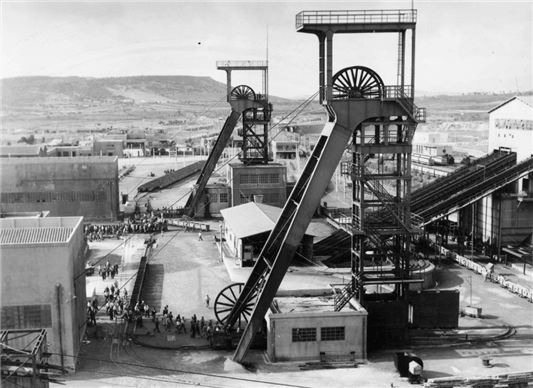
Carbonia was founded in Sardinia in 1938 as a planned mining town of Fascist Italy. The regime staged the town as a prestige project of its industrial policy. At its centre was the Serbariu mine, one of the country’s most important coal mines.
Coal extraction was closely linked to Fascist autarky policy. Italy sought to supply its own industry with domestic coal and reduce its dependence on foreign raw materials. For this purpose, Carbonia was equipped with workers’ housing, administrative buildings, squares and infrastructure. The town was meant to embody industrial strength, order and national self-sufficiency. Work in the Serbariu coal mine was physically demanding and took place under strict social control.
Personnel entrance to shafts 1 and 2 of the Serbariu mine
Fondo Ing. Dante Taddei, Direktor des Kohlebergwerks Serbariu, Carbonia
From the personal album, donated by the heirs
Archivio del Centro Italiano della Cultura del Carbone