
Pits & Perverts
Solidarity during the strike
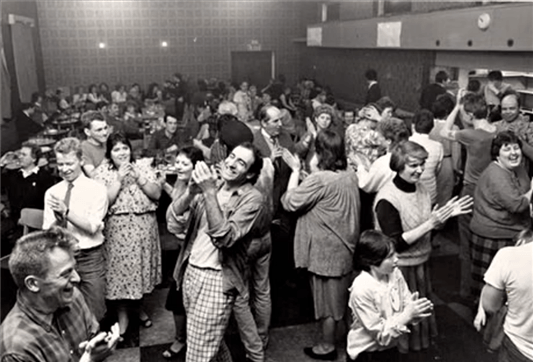
Lesbians and Gays Support the Miners (LGSM) was founded during the British miners’ strike of 1984 to 1985. While thousands of miners fought against pit closures, job losses and the destruction of entire industrial regions, lesbian and gay activists in London collected money for striking families. The first donations were gathered at London Pride in 1984. Soon afterwards, the group began meeting regularly around the bookshop Gay’s the Word, and later in larger premises. Its support was directed especially towards mining communities in South Wales, above all in the Neath, Dulais and Swansea Valleys, where the strike had existential consequences for months.
LGSM collected money outside clubs, in pubs, on the street and at events. The donations went to local strike committees and to families whose income had collapsed. One of the most famous campaigns was the benefit concert “Pits and Perverts”, held on 10 December 1984 at the Electric Ballroom in Camden. It was headlined by Bronski Beat with Jimmy Somerville. The title reclaimed a homophobic insult and turned it into a gesture of defiance. The concert raised several thousand pounds, some of which was used to fund a minibus for the Welsh mining families.
At first glance, polar opposites came together: urban queer scenes on the one hand, and traditionally shaped mining communities on the other. Yet both groups knew state pressure, media hostility, prejudice and political isolation. The miners were under immense pressure from the Thatcher government. Their strike funds were blocked, their communities were placed under heavy police surveillance, and the press often portrayed them as backward or violent. Lesbians and gay men likewise lived with police controls, media defamation and legal inequality. In these years, the AIDS crisis further intensified public stigma.
The alliance was built through personal encounters. Activists from London visited the Welsh communities; miners and their families came to London, collected donations, spoke at events and encountered queer spaces. Fundraising turned into mutual visits, shared celebrations, political conversations and lasting contacts. In Onllwyn and other places, LGSM was seen not simply as an external support group, but as a reliable part of the strike network.
The alliance changed both sides. In parts of the trade union movement, support for and understanding of LGBTQ+ rights grew. Within queer movements, social and economic struggles came more clearly into view as shared political concerns. Later, miners’ delegations publicly supported equality for homosexual people and also marched at London Pride.
Solidarity does not require sameness. It often arises where different groups recognise comparable experiences of exclusion, precariousness or loss of power, and begin to see separate struggles as connected. People who work, provide care or depend on wages often face similar issues despite very different lives: security, dignity, housing, participation and recognition.
Members of LGSM and miners dancing at the Welfare Hall in Dulais Valley, Wales. Siân James, in the floral dress, as well as Jonathan Blake, in the checked trousers, were central figures in the movement.
People’s History Museum, LGSM Archives
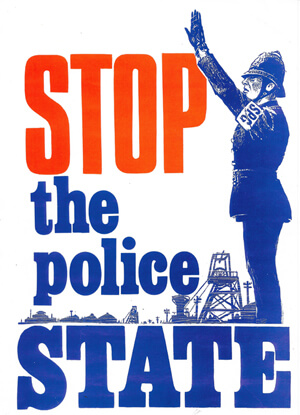
Stop the Police State
“Stop the Police State” was directed against the massive police violence during the British miners’ strike of 1984. The slogan also spoke to other marginalised groups: lesbians and gay men, anti-racist initiatives and left-wing movements recognised in it their own struggle against surveillance, criminalisation and state control.
Strike poster
1984
Produced by SOGAT (Society of Graphical and Allied Trades) for the National Union of Mineworkers
National Coal Mining Museum, YKSMM:2005.1