
Rudolf Brazda
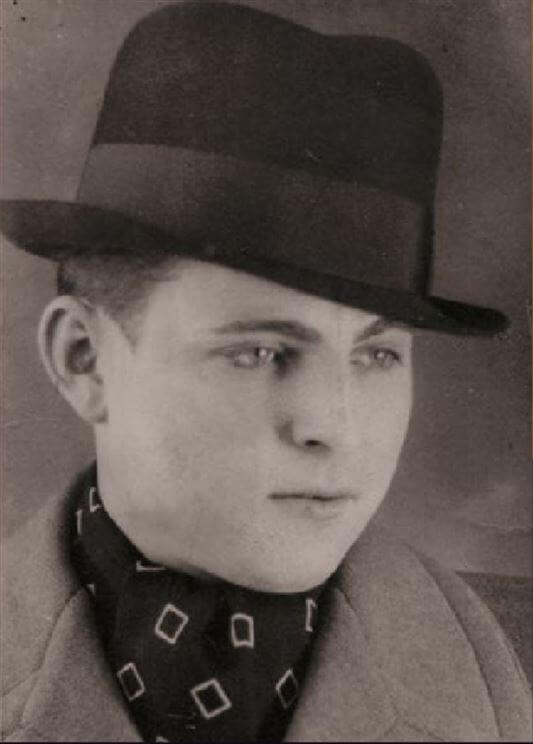
Rudolf Brazda was born in 1913 in Brossen near Zeitz, the son of Czech immigrants. He grew up in Germany, but did not have German citizenship. For this reason, he was denied the apprenticeship he wanted as a window dresser. Instead, he trained as a roofer.
Brazda had his first homosexual experiences during the Weimar Republic. Paragraph 175 already existed, “but it was ignored”, as he later recalled. For young men like him, this did not mean legal protection. Yet in many large cities, and also in some local milieus, there were spaces in which homosexuals could make contacts, form circles of friends and move more freely, at least for a time.
In 1933, Rudolf met the shop assistant Werner Bilz at an open-air swimming pool. “Suddenly I saw this beautiful young lad. I was almost beside myself, you could say. He was standing there in front of the pool, wearing a long bathrobe, and I thought, how on earth can I get together with him, should I speak to him? I ran over to him, but I couldn’t find any words. So I simply pushed him into the water, and then he was swimming, the bathrobe was dragging him down into the water, and luckily I was able to grab him straight away and pull him out of the pool. He laughed more than he cried and didn’t reproach me. Perhaps he had taken a liking to me too. That was how it was. At first sight. So I pulled him out, took off the robe, went with him into the shower and rinsed him down, dried him with the towel, and he liked that. I asked him straight away what we were doing that evening, and he said: ‘I don’t know, shall we meet?’”
The encounter became a relationship. At the time, Werner was renting a room from Helene Mahrenholz, a Jehovah’s Witness. Because of her faith, she might have been expected to reject homosexual relationships. Rudolf remembered, however, that she “welcomed me warmly right away, she knew about Werner, that he was like that, and she thought, now he has finally found a friend. […] She let me stay with him overnight straight away. After that I didn’t go home anymore.” Soon she even gave the two men her larger bedroom. In Meuselwitz, Rudolf and Werner led a life together that was unusually visible for the early Nazi period.
Rudolf Brazda
early 1930s
Brazda estate / in: Alexander Zinn, Das Glück kam immer zu mir. Rudolf Brazda: Das Überleben eines Homosexuellen im Dritten Reich, Frankfurt am Main 2011.
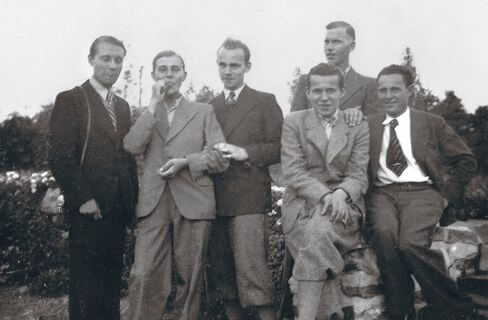
A circle of friends formed around Rudolf and Werner. In the apartment, they celebrated, listened to the radio, drank coffee, played cards, danced and performed in drag. Brazda particularly loved Josephine Baker, whose dancing he had imitated since his youth. Within their closer social circle, the friends made little secret of their homosexuality. Relatives knew. Brazda later recalled a “wedding” of his own with Werner in 1934, at which a relative played the priest and friends appeared in women’s clothing. “People were so tolerant back then,” Brazda said in retrospect. “They simply accepted it, a life like the one we homosexuals led.”
After the Nazis came to power, the situation for homosexual men became more dangerous. In the summer of 1934, Hitler had the then leadership of the SA eliminated, including its chief of staff Ernst Röhm. Röhm’s homosexuality was known and had long been tolerated by Hitler. After Röhm’s murder, the regime exploited it for propaganda purposes and declared homosexual men a threat to the state. Men who loved men were considered unreliable, open to blackmail and incapable of conforming to the Nazi ideal of hardness, discipline and reproduction.
In 1935, the Nazi regime tightened Paragraph 175. Prosecutors no longer had to prove an act resembling intercourse. Touches, kisses, letters, statements by third parties or forced confessions could be enough. That same year, Rudolf’s acquaintance Artur Sachs was arrested in Leipzig.
In Altenburg, the persecution of homosexuals ordered from Berlin initially got off to a slower start. This changed in early 1937, after the Altenburg criminal police had been trained by officers from Weimar. Rudolf Brazda was also arrested in Leipzig in 1937 as part of a major wave of persecution. He was interrogated and held in pre-trial detention for four weeks before finally confessing to his relationship with Werner. A week later, the Regional Court of Altenburg sentenced him to six months in prison.
The Meuselwitz circle of friends. From left: Werner Bilz, Helmut Heuer, Moritz Engelhardt, Hans Schreiber, Arne Just, Rudolf Brazda
early 1930s
Brazda estate / in: Alexander Zinn, Das Glück kam immer zu mir. Rudolf Brazda: Das Überleben eines Homosexuellen im Dritten Reich, Frankfurt am Main 2011.
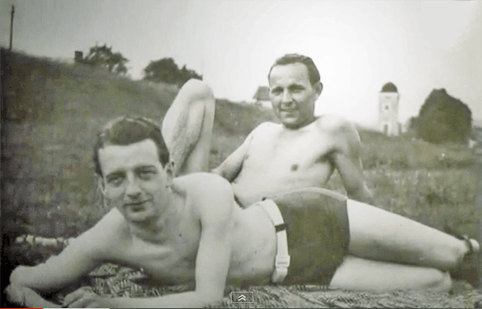
In October 1937, Brazda was released from prison and deported to Czechoslovakia because of his parents’ origins. He spoke hardly any Czech and therefore moved to the German-speaking Sudetenland, where he joined a Jewish theatre troupe, appeared in operettas and made audiences laugh as a dancer with his Josephine Baker imitations. In Karlsbad, he lived together with his new boyfriend, Anton.
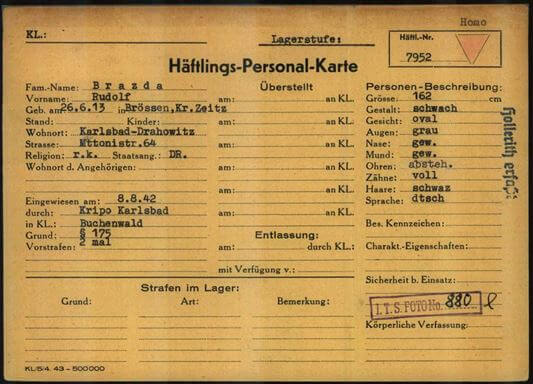
With the annexation of the Sudetenland in October 1938, Nazi persecution caught up with him once again. Rudolf was arrested again in 1941 and sentenced to 14 months in prison as a “repeat offender”. After serving his sentence, however, he was not released. Like many homosexual men, he was deported to Buchenwald concentration camp in 1942. He was given prisoner number 7952 and had to wear the pink triangle, which identified homosexual prisoners.
1939
Brazda estate / in: Alexander Zinn, Das Glück kam immer zu mir. Rudolf Brazda: Das Überleben eines Homosexuellen im Dritten Reich, Frankfurt am Main 2011.
Buchenwald concentration camp was established in 1937 on the Ettersberg near Weimar, with a limestone quarry on its southern slope. The stone extracted there was originally intended for the monumental buildings planned in Weimar, the capital of the Gau. The quality of the limestone, however, proved poor, so it was used mainly for paths, roads and camp buildings.
In the quarry, limestone was blasted out of the slope. The large chunks had to be broken up by hand, gathered together and loaded onto carts. Beatings, poor nutrition, simple tools and lack of rest quickly led to physical collapse. The quarry was also a place of execution. Murders were often disguised in the records as escape attempts.
In Buchenwald, homosexual prisoners were particularly often assigned to the penal company that had to work in the quarry. Rudolf Brazda, too, was initially sent there. He later recalled: “I was given a shovel, and I had to gather up the broken stones with the shovel and then shovel them into the cart.” For many prisoners, the quarry became a place of death. The SS also understood hard forced labour as a means of “re-education”. Those who could not be broken were to be destroyed.
In the quarry, functionary prisoners known as kapos also guarded the other prisoners. The kapo of the quarry, Alfred Müller, a political prisoner, was considered especially brutal. It soon became clear that Müller had a sexual interest in Rudolf. For Brazda, this situation was life-threatening. To resist the desire of a brutal kapo could mean beatings, penal labour or death. He gave in to Müller’s pressure.
Müller arranged for Brazda to be transferred to another work detail. He was first sent to a medical hut and later to a construction commando. This transfer probably saved his life, but even outside the quarry Brazda remained in danger.
Shortly before the end of the war, Brazda was threatened with the evacuation of the camp. On such death marches, countless prisoners died from exhaustion, hunger, cold or shots fired by the guards. With the help of a kapo, Brazda was able to hide in a tool shed near the pigsty. He remained hidden there for several weeks and was supplied with food.
On 11 April 1945, the US Army liberated Buchenwald concentration camp. Rudolf was 32 years old. He went to Alsace with a former fellow prisoner. In France, homosexuality was not criminalised in the same way as in Germany.
Prisoner personnel card from Buchenwald concentration camp for Rudolf Brazda. The prisoner number at the top right is marked with the pink triangle and the note “Homo”.
8 August 1942
Spurce: Arolsen Archives, 5607289
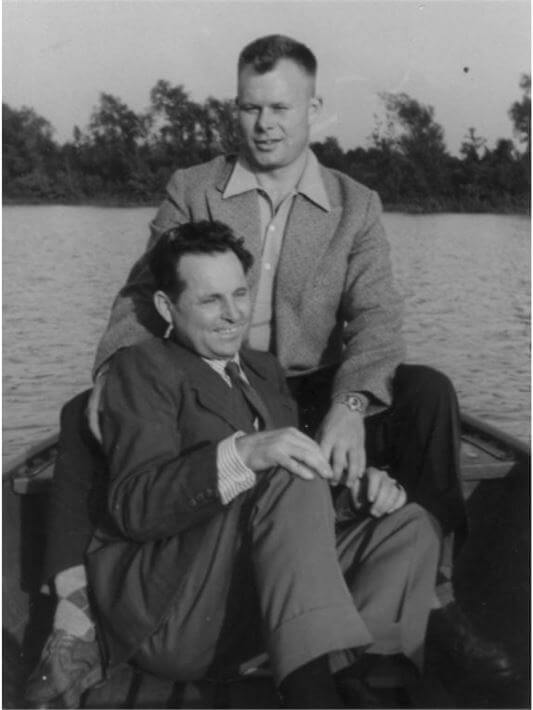
In 1950, Rudolf met his future life partner Edouard Mayer, whom he called Edi. After Werner, Edi became the second great love of Rudolf’s life. When Edi became dependent on a wheelchair after a work accident, Brazda cared for him for many years. Together they built a house in Bantzenheim. The two remained together until Edi’s death in 2003.
For a long time, Brazda hardly spoke publicly about his persecution. Like many men marked with the pink triangle, he received no adequate compensation. Only in old age did Brazda step into the public eye. When the Memorial to Homosexuals Persecuted under Nazism was inaugurated in Berlin in 2008, it was initially assumed that there were no surviving members of this persecuted group left. Through his niece, it became known that Rudolf Brazda was still alive and willing to speak. In the final years of his life, Brazda became an important eyewitness. He spoke about his love for Werner, about the arrests, about Buchenwald and about life after liberation. In doing so, he retained an openness that had already marked his youth. “After everything I have suffered, I know no fear anymore,” he said in retrospect.
Rudolf Brazda died in Bantzenheim on 3 August 2011 at the age of 98.
1960s
Brazda estate / in: Alexander Zinn, Das Glück kam immer zu mir. Rudolf Brazda: Das Überleben eines Homosexuellen im Dritten Reich, Frankfurt am Main 2011
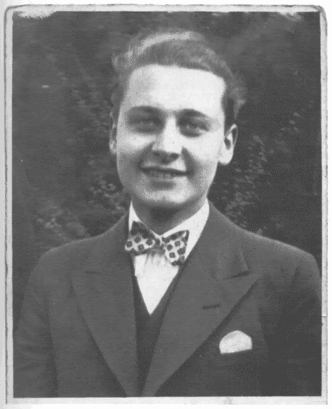
Werner Bilz
In 1933, he met Rudolf Brazda there, and the two fell in love. Until Bilz was called up to the Wehrmacht in 1936, they lived together with Helene Mahrenholz. A homosexual circle of friends soon formed around the two men.
In 1935, Bilz was arrested for the first time during a raid, together with several of their Meuselwitz friends, including Reinhold Winter. He was summoned and interrogated, but the proceedings came to nothing.
After serving his sentence, Brazda was expelled from Germany. Only several years later, after the German occupation of the Sudetenland, did the two meet again. At a celebration in Bilz’s hometown of Limbach, they danced together one last time.
Werner Bilz served on the Eastern Front and probably fell in Romania in 1943. On 31 December 1949, he was declared dead.
Werner Bilz
mid-1930s
Brazda estate / in: Alexander Zinn, Das Glück kam immer zu mir. Rudolf Brazda: Das Überleben eines Homosexuellen im Dritten Reich, Frankfurt am Main 2011
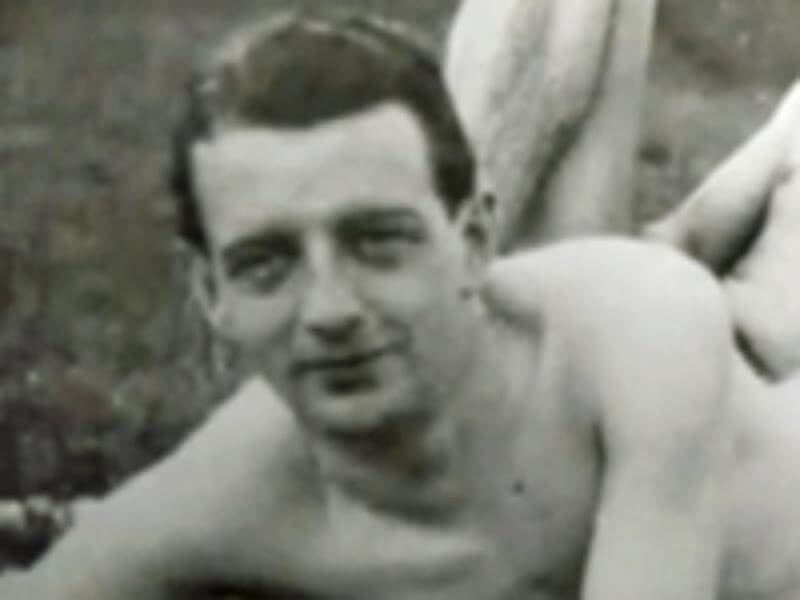
Anton Hartl
At the end of August 1938, Hartl met the stagehand Rudolf Brazda in Sodau near Karlsbad. Brazda later recalled: “Toni had a connection with the theatre troupe because he liked doing hair, and he saw me, we happened to meet at a urinal.” A few days later, the two celebrated Hartl’s 22nd birthday. Brazda described the beginning of their relationship as follows: “One time we were outside, it was dark, and suddenly, because I could see he was into me, I took him in my arms and kissed him. From then on he was head over heels for me.”
After the German invasion in October 1938, the Fischli-Bühne was disbanded. Hartl and Brazda moved to Karlsbad. Hartl worked there as a hairdresser, while Brazda was unemployed and was supported by him. They rented two attic rooms opposite one another and used the landing between the rooms as a shared living area. At the same time, they lived in constant fear of being discovered by the criminal police.
At the end of 1940, an anonymous tip set extensive investigations by the Karlsbad criminal police in motion. On 1 April 1941, Brazda was arrested; on 7 May, Hartl was arrested as well, by then a member of the Wehrmacht. Hartl was initially imprisoned in Regensburg and, at the end of May, transferred to the court prison in Eger. On 5 September 1941, Hartl’s 25th birthday, the Regional Court of Eger sentenced him to eight months in prison under Paragraph 175. Brazda received 14 months.
The court regarded Hartl as the one “seduced” by Brazda and took this into account as a mitigating factor. Hartl served the first months of his sentence in the court prison in Eger. At the end of November 1941, as a member of the Wehrmacht, he was transferred to the Wehrmacht prison Torgau-Brückenkopf.
Anton Hartl survived the war and later moved to Essen. He regularly visited Rudolf Brazda in Alsace.