
Hermann Hußmann
Hermann Hußmann was born on 20 December 1908 in Bochum-Riemke. He grew up in a Catholic mining family and lived with his family in the miners’ settlement “Im Mühlental”. After attending elementary school in Hofstede, he began work at shaft II of the Constantin der Große colliery. Like his father and many men around him, he entered the mining world early.
Hußmann himself later stated that he had his first same-sex experiences as a teenager. During an interrogation on 6 February 1943, he said that, at the age of sixteen, he had had sexual contact with a friend from school and the colliery. Later, he continued to seek contact with men, especially in Bochum. The investigation files also point to a long-standing close relationship with a man from Düsseldorf.
Under the Nazi regime, homosexual men were systematically monitored, criminalised and persecuted. The legal basis was Paragraph 175, tightened in 1935, which defined sexual acts between men far more broadly than before. For Hußmann, this meant that his relationships, letters, memories and social contacts could all become evidence against him. In February 1943, he was arrested, interrogated and charged. The police confiscated letters, photographs and personal papers. In April 1943, he was indicted for “offences against morality” and, among other charges, under Paragraphs 175, 20a and 42e. These provisions could be used to further criminalise those affected as “dangerous” or “habitual” offenders.
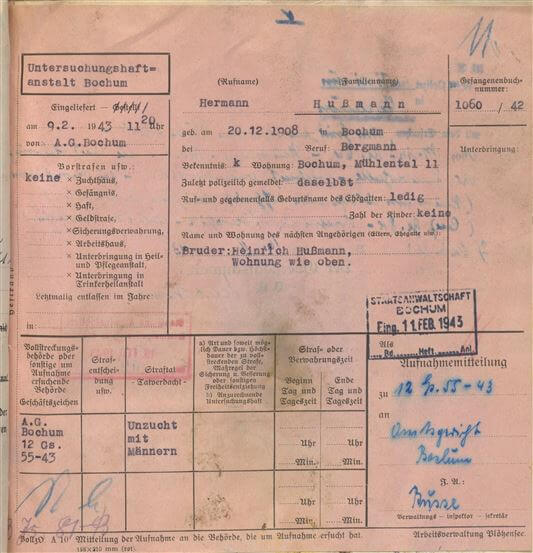
Hußmann's admission to the remand prison on 9 February 1943
Landesarchiv Westfalen, Münster, Bochum Public Prosecutor's Office, No. 7414
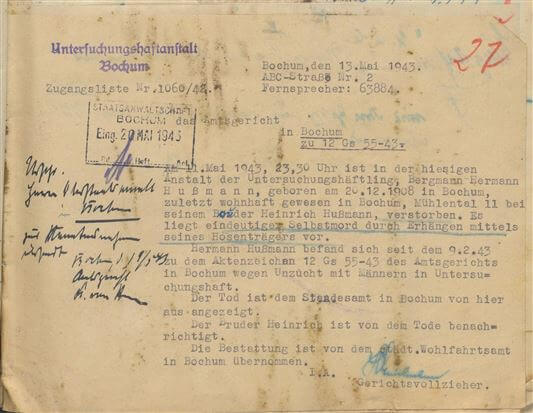
Hußmann had been held in pre-trial detention in Bochum since 9 February 1943. The reason given was “fornication with men”. The case never came to trial. According to a notice issued by the remand prison, Hermann Hußmann died by suicide on 11 May 1943. On the basis of the surviving sources, it is no longer possible to determine with certainty whether this official account fully reflects what happened.
There is much to suggest that he could no longer withstand the immense pressure of persecution, the prospect of conviction and the possibility of further imprisonment. For a miner from a Catholic working-class settlement, arrest also meant the collapse of the protective spaces around him: family, work, neighbourhood and reputation were all immediately affected. Today, a street and a Stolperstein in Bochum commemorate Hermann Hußmann.
Notice from the remand prison in ABC-Straße to the Bochum District Court concerning the death of Hermann Hußmann
Landesarchiv Westfalen, Münster, Bochum Public Prosecutor's Office, No. 7414