
Erich Schnormeier
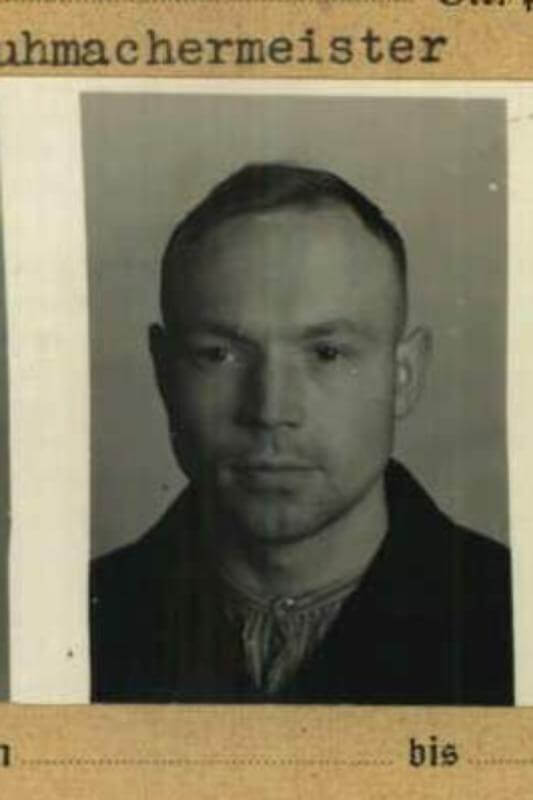
Erich Schnormeier was born on 21 October 1909 in Schwelentrup, Lippe. He lived in Blomberg and worked as a master shoemaker. His personnel form from Flossenbürg concentration camp records him as unmarried, German and Protestant. The same files also note his earlier membership of the Nazi Party, from September 1930 to February 1938.
On 17 January 1938, the Bielefeld Gestapo issued a protective custody order against Schnormeier. It was justified on the grounds that he was suspected of having had “homosexual or abnormal sexual intercourse” with men. In his interrogation, Schnormeier stated that he had had sexual contact several times with the merchant Paul Stumpf from Blomberg. Between August 1936 and June 1937, the two had allegedly met several times on secluded roads and in doorways. Statements of this kind must be treated with caution. They come from a Gestapo interrogation, may have been made under pressure and cannot be read as voluntary accounts.
On 14 April 1938, Schnormeier was sentenced to one year in a penitentiary under Paragraph 175. When his prison sentence ended, he was not released. On 16 March 1939, he was transferred to the “education tower” of Sachsenhausen concentration camp; on 7 December 1939, he was sent to Flossenbürg concentration camp.
In one interrogation, Schnormeier stated that he had had sexual contact several times with the merchant Paul Stumpf from Blomberg between August 1936 and June 1937. Such statements were made under conditions of arrest, Gestapo investigation and threat of punishment. They are therefore not a neutral account of private relationships. Above all, they document how the authorities recorded same-sex contacts, judged them and used them as the basis for further persecution.
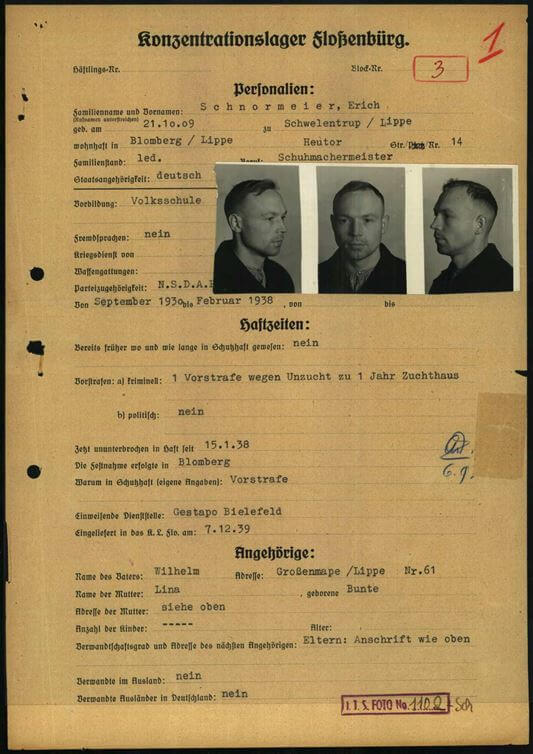
After serving his penitentiary sentence, Schnormeier was not released, but was transferred first to Sachsenhausen concentration camp and later to Flossenbürg concentration camp.
Because of the large granite deposits at Flossenbürg, the SS considered the site suitable for a concentration camp. Granite, an extremely hard and durable stone, was regarded as especially “German” and as an ideal building material for the “thousand-year Reich” the Nazis intended to construct. For this purpose, the German Earth and Stone Works, or DESt, were founded, and concentration camp quarries were established. Prisoners were exploited there as forced labourers, among them Erich Schnormeier.
In November 1940, Erich Schnormeier was released from the concentration camp. What became of him later is not recorded, apart from denazification files created after 1945. These were probably connected to his earlier membership of the Nazi Party.
Personnel file of Erich Schnormeier from Flossenbürg concentration camp
1939
Arolsen Archives, 10996671