
Friedrich Alfred Krupp
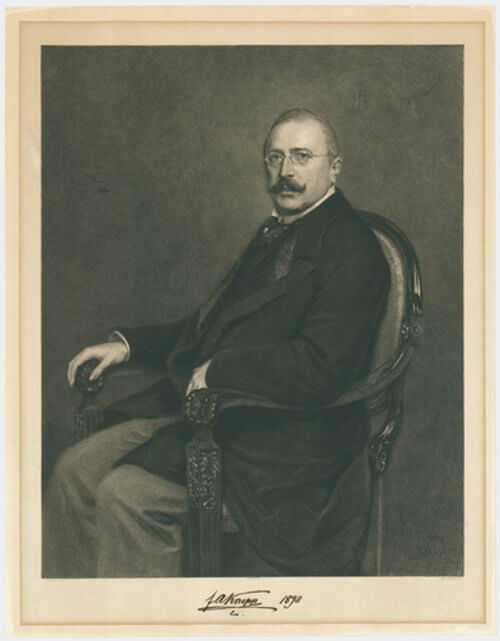
Friedrich Alfred Krupp was born in Essen in 1854. In 1887, after the death of his father Alfred Krupp, he took over the company, which had by then become one of the largest industrial corporations in Europe. Krupp produced steel, railway materials, ships and armaments. To do so, the company needed a steady supply of large quantities of coal and iron ore. Rather than leaving this supply to the market, Krupp bought mines, mining shares and smelting works. The group thus brought ever larger parts of its own production chain under its control, from the extraction of raw materials to the finished steel product.
Friedrich Alfred Krupp continued to expand the company. Under his leadership, production grew, the firm developed new steel alloys, extended its armaments business and became even more closely tied to the German Empire. Krupp was an industrialist, a member of the Reichstag and a close confidant of Wilhelm II. At the same time, his health remained fragile, and from the late 1890s onwards he regularly spent extended periods on Capri. There he took an interest in marine research, funded scientific work and had the famous Via Krupp built, a winding path between the heights of Capri and Marina Piccola.
From the late 1890s onwards, Krupp regularly spent long periods on Capri. He financed marine biological research, lived for a time at the Grand Hotel Quisisana and had the Via Krupp laid out between the upper part of Capri and Marina Piccola. His circle included the Congrega di Fra Felice, a group of acquaintances and companions. In the winter of 1901 to 1902, Krupp had a cave at Marina Piccola enlarged. It was intended as a private place for gatherings and festivities within this circle.
The scandal of 1902 centred on this cave. Italian newspapers accused Krupp of having organised sexual encounters with young men there. At the same time, there were suspicions that a journalist had used the allegations for blackmail. Krupp learned of the accusations in June 1902. In October, the Italian newspaper Propaganda attacked him publicly. On 15 November, the Social Democratic newspaper Vorwärts also reported on the case and described Krupp as homosexual; in the same context, the paper called for the abolition of Paragraph 175.
Whether the accusations were true remains disputed. The reports emerged in a climate of political hostility, sensationalist journalism, class conflict and homophobia. Krupp denied the allegations and brought legal action against the newspaper. Kaiser Wilhelm II also publicly backed him. At the same time, the rumours persisted. Krupp had a close, possibly homoerotic connection over many years with Giovanni Sangiorgio, a young man from Capri. Their contact probably began as early as the late 1880s. Whether it developed into a love relationship cannot be established with certainty. A few days after the article in Vorwärts, Krupp died on 22 November 1902 at Villa Hügel in Essen. The official cause of death was given as a stroke. Several newspapers suspected suicide.
After Friedrich Alfred Krupp’s death, the company passed to his daughter Bertha and her husband Gustav von Bohlen Halbach. Gustav, and later their son Alfried, continued to run the company, which during the Weimar Republic and later under Nazism again became one of the regime’s most important arms producers. Concentration camp prisoners and forced labourers were also made to work for the group. After 1945, Alfried Krupp was convicted in the Nuremberg Krupp Trial, later pardoned and had his fortune returned to him.
Etching of a portrait of Friedrich Alfred Krupp
etching by Albert Krüger, 1898
original painting by Ludwig Noster, 1896
Deutsches Bergbau-Museum Bochum – Leibniz-Forschungsmuseum für Georessourcen, 030350540001
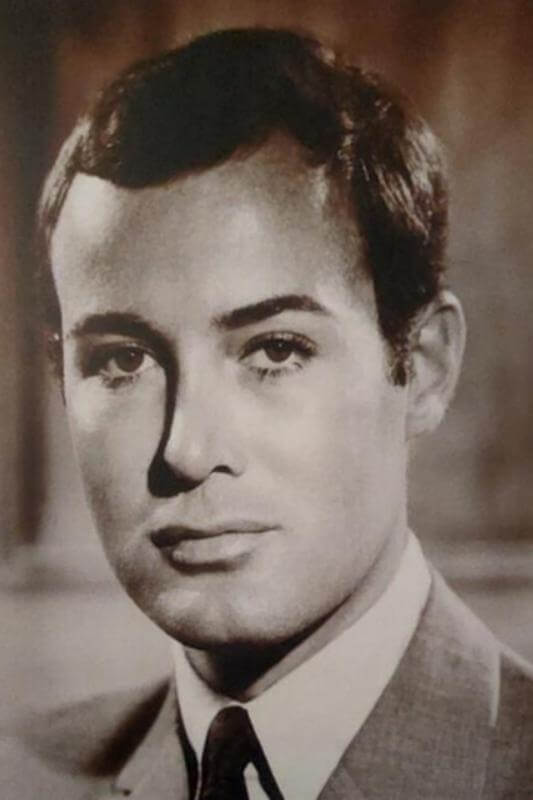
Arndt von Bohlen und Halbach
With Arndt von Bohlen und Halbach, Alfried’s only son, other motifs from the family history reappeared: wealth, scandal, homosexuality and the question of who was allowed to bear the Krupp name. Arndt carried the legacy of a family whose company had been central to the Nazi armaments industry. At the same time, his lifestyle made him vulnerable to attack and widely disliked. He was an immensely wealthy homosexual heir, eccentric, visible and marked early on as an outsider.
Arndt had been intended as the heir, but in 1966 he renounced both the company and the name. In return, he received a large annual allowance. He lived as a jet-set heir between Kitzbühel, Sylt, Marrakesh, Palm Beach and Munich. His homosexuality was publicly known, and his appearance and lifestyle constantly fed the tabloid press. Arndt died in Munich in 1986 at the age of 48.
Arndt Krupp
Source: kuladig.de