
#besties or lovers?
Do we only recognise past identities when they use the words we are familiar with?
People who love someone of the same sex, or who crossed the gender roles expected by their society, have existed in every period of history. Ancient sources already speak of relationships between men and between women. In the Middle Ages and the early modern period, such lives appear in court records, chronicles and saints’ legends.
Queer identities are therefore not a modern invention. Their self-understanding, however, differed from ours. Modern terms such as “lesbian”, “gay”, “trans” or “queer” did not yet exist. The clear distinction between homosexual and heterosexual preference only became established as a concept around 1870.
In historical research, this is known as the problem of anachronism. Present-day identity terms cannot simply be transferred to earlier societies. People’s sense of self was different, and so were language, gesture and expressions of affection. This makes it difficult for historians to define relationships precisely. Were two people close friends? Siblings? Housemates? Teacher and pupil? Confidants? Or lovers?
The semantics of friendship play an important role here. In premodern Europe, “ideal friendship” between men was often seen as the highest and spiritually purest form of attachment, far above marriage, which was mainly as a practical arrangement. The passionate language found in old letters can sound like a declaration of love to us today. At the time, it was often part of a common rhetorical style among close friends. Without clear evidence of physical intimacy, historical interpretations therefore often remain cautious, in order to respect the integrity of the period.
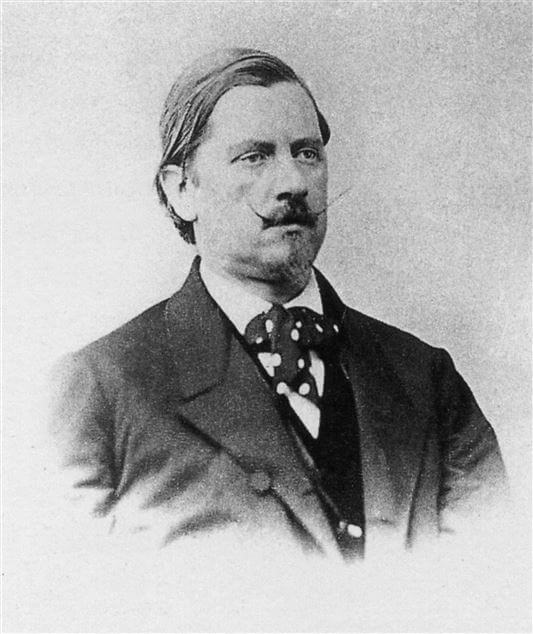
Karl Maria Kertbeny ( 1824-1882)
Karl Maria Kertbeny (1824 to 1882) was an Austro-Hungarian writer, translator and publicist. He became best known for the terms he coined. In 1868, he apparently used the word “homosexual” for the first time in a letter. In 1869, “homosexuality” appeared in print for the first time in an anonymous pamphlet opposing the criminal prosecution of sexual acts between men.
Kertbeny argued from a legal perspective, rather than a religious or medical one. Same-sex desire, he maintained, was not a freely chosen vice and should therefore not be punished. His terms were later adopted by medicine, sexology and public discourse, and shaped the distinction between homosexual and heterosexual orientation.
Whether Kertbeny himself desired men cannot be stated with certainty. In public, he described himself as “normalsexual”. He publicly explained his commitment to the cause through the suicide of a young friend who had been blackmailed because of same-sex inclinations. His diaries, however, suggest that he was attracted to male beauty and that he had homosexual experiences.
Karl Maria Kertbeny
ca. 1850.
from: Goodbye to Berlin? 100 Jahre Schwulenbewegung (Berlin: Verlag rosa Winkel, 1997)