
Magnus Hirschfeld
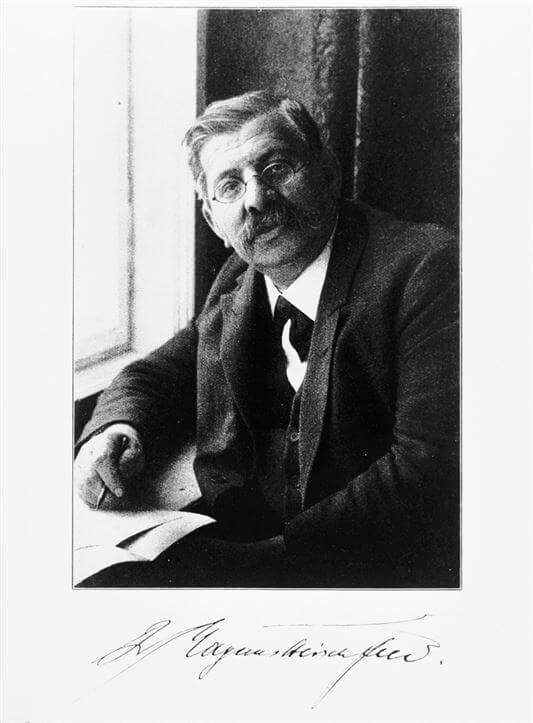
Magnus Hirschfeld was born on 14 May 1868 in Kolberg in Pomerania, today Kołobrzeg in Poland. He grew up in a Jewish medical family and went on to study medicine in Strasbourg, Munich, Heidelberg and Berlin. After completing his doctorate, he worked as a physician and settled in Berlin. There he became one of the most important figures in early sexology and in the homosexual emancipation movement.
Hirschfeld was himself homosexual, but he never came out and never addressed his own sexual orientation in his publications. Homosexuality was a criminal offence in the German Empire, and his scientific authority also depended on being taken seriously not simply as someone personally affected, but as a physician, researcher and expert witness.
In 1897, Hirschfeld co-founded the Scientific-Humanitarian Committee in Berlin. It is regarded as one of the first organisations in the world to campaign continuously for the rights of homosexual people. Its main aim was the abolition of Paragraph 175, which criminalised sexual acts between men. Hirschfeld collected expert opinions, wrote pamphlets, organised petitions and sought support from lawyers, doctors, politicians, artists and intellectuals. “Per scientiam ad justitiam” was the motto of Hirschfeld and the Committee: “Through science to justice.”
For Hirschfeld, same-sex desire was not an illness, not a sin and not a crime. He understood sexuality and gender as diverse. With his theory of “sexual intermediaries”, he attempted to describe the many different ways in which body, desire, appearance and sense of self can interact in human beings. He coined the term “transvestite”, which is outdated today but was understood at the time as a value-neutral term. What mattered in his time was that he did not want to cure, punish or erase queer people, but to establish their existence scientifically and protect them legally.
In 1919, Hirschfeld founded the Institute for Sexual Science in Berlin. It was at once a research centre, archive, library, counselling service, medical practice and public education centre. People came there for advice on marriage, contraception, sexually transmitted diseases, homosexuality, trans identity and gender self-determination. The Institute also offered free counselling and treatment to poorer visitors. During the Weimar Republic, it became internationally known and attracted researchers, patients and visitors from many countries.
Magnus Hirschfeld
signed portrait
12 November 1927
US Holocaust Memorial Museum, courtesy of Magnus-Hirschfeld Gesellschaft
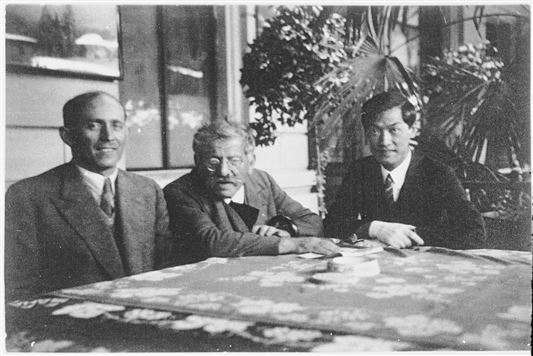
Karl Giese was Hirschfeld’s lover and long-term companion. He was considerably younger than Hirschfeld and became part of his circle in the early 1920s. The two lived together, travelled together and worked at the Institute for Sexual Science. Giese was employed there as an archivist, librarian, curator and lecture assistant.
From 1930 onwards, Hirschfeld undertook an extended world tour. He gave lectures, met specialists and presented his sexological work internationally. In 1931, he met the young medical student Li Shiu Tong, also known as Tao Li, in Shanghai. Li became his student, secretary, travelling companion, carer and eventually also his partner. In the final years of Hirschfeld’s life, both Giese and Tao Li were at his side. Several accounts describe this constellation as a ménage à trois.
Magnus Hirschfeld (centre) with Tao Li (right) and institute employee Bernhard Schapio
Institute for Sexual Science, E. Haeberle, Berlin
unknown date
US Holocaust Memorial Museum, courtesy of Magnus-Hirschfeld Gesellschaft
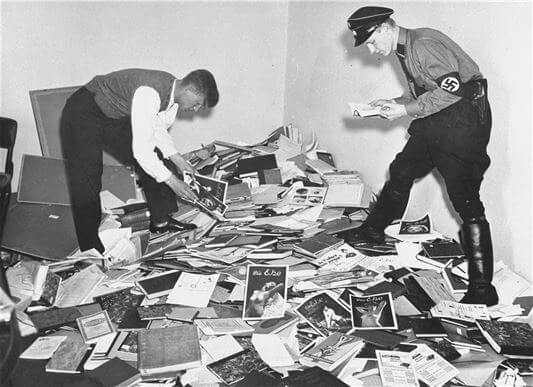
When the Nazis came to power in 1933, Hirschfeld was abroad. He never returned to Germany. On 6 May 1933, the Institute for Sexual Science in Berlin was looted and destroyed. A few days later, Nazi students and men of the Sturmabteilung burned books, files and collection items from the Institute on Berlin’s Opernplatz. In his will, Hirschfeld had appointed Giese and Tao Li to carry on his work. After the Institute had been ransacked, its holdings burned and its staff driven into exile, that work had almost no real chance of continuing. Giese was able to rescue only parts of the library and archive.
Hirschfeld spent his final years in exile in Switzerland and France. He died in Nice on 14 May 1935, his 67th birthday. Giese tried to secure the surviving parts of Hirschfeld’s estate. He later lived in Brno, impoverished and once again under political threat. On 16 March 1938, a few days after Nazi Germany’s annexation of Austria, he took his own life. The parts of Hirschfeld’s estate that had remained with him were later largely lost in the Holocaust.
Li first went to London, then returned to Zurich. He later studied at Harvard and worked for a time at the Chinese embassy in Washington. Afterwards he lived again in Zurich, later in Hong Kong and finally in Vancouver, where he died in 1993. For decades, he carried Hirschfeld’s death mask, letters, photographs and other personal belongings with him. Only after Li’s death were parts of this estate rediscovered.
Nazi students and members of the Sturmabteilung loot the library of the Institute for Sexual Science
Manfred Baumgardt
Berlin
US Holocaust Memorial Museum, courtesy of National Archives and Records Administration, College Park