
Gerd Katter
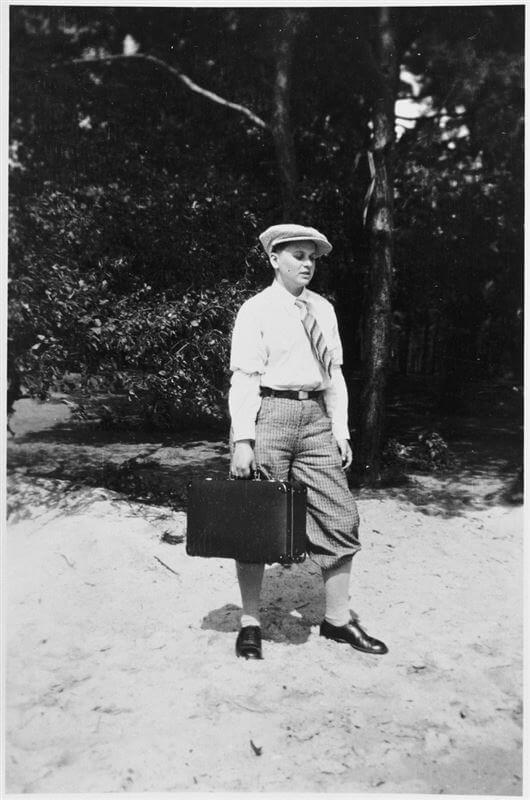
Gerd Katter was born in Berlin in 1910 and was given the name Eva at birth. From his youth, he lived as a man and sought support at Magnus Hirschfeld’s Institute for Sexual Science. During the Weimar Republic, the Institute was one of the most important places of contact for people who needed medical advice, expert opinions or protection from police intervention because of their sexuality or gender identity.
Katter first came to the Institute as a patient at the age of sixteen. There he underwent gender-affirming operations, including a mastectomy.
He was later presented in seminars at the Berlin Police College. These presentations were intended to familiarise police officers with people who were then classified under the term “transvestites”. In the Weimar Republic, the term had a broader meaning than it does today and could also refer to people we would now describe as trans.
Gerd Katter
ca. 1929
US Holocaust Memorial Museum, courtesy of Magnus-Hirschfeld Gesellschaft
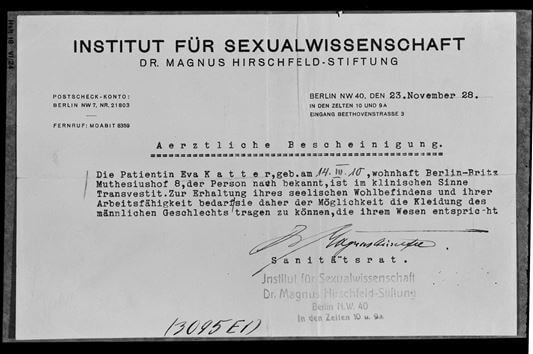
In 1928, the Institute issued Katter a medical certificate. It stated that, for his mental wellbeing and his ability to work, it was necessary for him to be able to wear male clothing. On 6 December 1928, he received a so-called “transvestite certificate” from the Berlin police. The document recorded that Katter was known to the police as a person who wore men’s clothing.
Such certificates offered a degree of protection during police checks, but they also make clear how dependent trans and gender-nonconforming people were on medical assessment and police tolerance. Katter’s papers remained tied to the name assigned to him at birth, while in everyday life he lived as a man. He later trained as a carpenter and worked, among other things, as an insurance representative.
After the Nazis came to power, Hirschfeld’s Institute was looted and destroyed in 1933. Many files, books and collection items were burned or dispersed. Katter survived the Nazi period. After the Second World War, he continued to live as a man in East Germany. He later lived in Birkenwerder in Brandenburg, where he also performed as a singer at events. Gerd Katter died in Birkenwerder in 1995.
Gerd Katter's medical certificate, signed by Magnus Hirschfeld
23 November 1928
US Holocaust Memorial Museum, courtesy of Magnus-Hirschfeld Gesellschaft