
Clothes make the man
Between emancipation, theatre and everyday life
In many historical societies, clothing expressed status, occupation, gender and social belonging. Anyone who wore clothing that did not correspond to their assigned gender crossed a social boundary and, at times, could even be prosecuted.
This makes historical interpretation difficult. When a person assigned female at birth wore men's clothing, worked as a man or lived under a male name, this could mean different things. It could be a way of gaining access to spaces that were closed off to women: work, wages, travel or education. It may also mean that we are dealing with people we would today describe as trans men or non-binary. The sources often don't allow us to decide with certainty, because they usually speak from the outside. Courts, clergy, chroniclers and authorities recorded what they perceived as a breach of order. What the people concerned thought about themselves was rarely written down. Some statements were also made under duress, for example during interrogations or court proceedings. Silence, therefore, cannot simply be read as agreemennt with the official interpretation.
There are also documented cases of people assigned male at birth who lived as women, used female names or did not want to be understood as men. Here, too, caution is necessary. Travesty, theatrical roles and masquerade had existed for centuries. But not every female presentation was intended for the stage. Some people lived this gender role in everyday life as well.
Where sources describe long-term living, working, loving or appearing publicly in another gender role, the line between disguise, social strategy and lived identity becomes blurred.
This makes historical interpretation difficult. When a person assigned female at birth wore men's clothing, worked as a man or lived under a male name, this could mean different things. It could be a way of gaining access to spaces that were closed off to women: work, wages, travel or education. It may also mean that we are dealing with people we would today describe as trans men or non-binary. The sources often don't allow us to decide with certainty, because they usually speak from the outside. Courts, clergy, chroniclers and authorities recorded what they perceived as a breach of order. What the people concerned thought about themselves was rarely written down. Some statements were also made under duress, for example during interrogations or court proceedings. Silence, therefore, cannot simply be read as agreemennt with the official interpretation.
There are also documented cases of people assigned male at birth who lived as women, used female names or did not want to be understood as men. Here, too, caution is necessary. Travesty, theatrical roles and masquerade had existed for centuries. But not every female presentation was intended for the stage. Some people lived this gender role in everyday life as well.
Where sources describe long-term living, working, loving or appearing publicly in another gender role, the line between disguise, social strategy and lived identity becomes blurred.
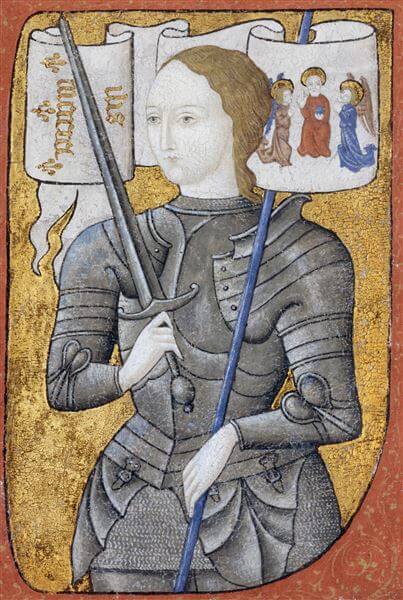
Jeanne d'Arc
Joan of Arc first wore men's clothing in a military context: as a rider, fighter and companion to an army. Later, she continued to wear male clothes in prison. At her trial in 1431, she was attacked not only for her voice and political actions, but also for her appearance. Her clothing was interpreted as a breach of divine and social order and became a central point of accusation. Joan herself stated that she was acting on God's command.
In prison, men's clothing could also offer protection from assault, as it fastened more closely and was harder to remove. This chastity later became important. It fitted the image of a virgin guided by God. At her rehabilitation in 1456 and her later canonisation in 1920, the accusation concerning men's clothing receded behind piety, purity and obedience to God. Whether her clothing was motivated primarily by religion, military necessity, practical reasons or personal convictionn remains disputed.
Joan of Arc in a historical initial.
Miniature from the late 19th century, attributed to the painter and collector Georges Spetz or to the so-called "Spanish Forger".
French National Archives, AE-II-2490.
In prison, men's clothing could also offer protection from assault, as it fastened more closely and was harder to remove. This chastity later became important. It fitted the image of a virgin guided by God. At her rehabilitation in 1456 and her later canonisation in 1920, the accusation concerning men's clothing receded behind piety, purity and obedience to God. Whether her clothing was motivated primarily by religion, military necessity, practical reasons or personal convictionn remains disputed.
Joan of Arc in a historical initial.
Miniature from the late 19th century, attributed to the painter and collector Georges Spetz or to the so-called "Spanish Forger".
French National Archives, AE-II-2490.