
Laudomia Forteguerri & Margarete of Austria
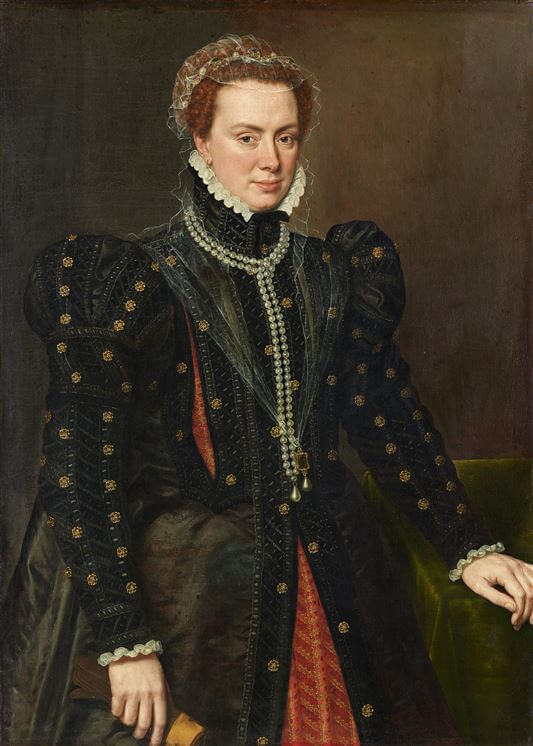
Laudomia Forteguerri was a poet from Siena. Of her six surviving sonnets, five are addressed to Margarethe of Austria, the illegitimate daughter of Emperor Charles V and later Duchess of Parma. The two women met in 1533 or 1536, probably in courtly and literary circles. Laudomia was then about seventeen or twenty years old, Margarethe seven years younger. Despite this age difference, contemporaries described their meeting as an immediate mutual attraction. Alessandro Piccolomini wrote that as soon as the two had seen one another, they were seized by the “most ardent flames of love”. As a visible sign, he referred to their frequent visits to one another.
Laudomia’s poems address Margarethe as a beloved woman. They ask for closeness, consolation and reciprocation. In the texts, Margarethe appears as a “diva”, a divinely elevated woman whose beauty and presence both delight and torment Laudomia. The speaker describes herself as bound, suffering and dependent on the beloved. She asks to be released from her misery and kept close to her “goddess”. The language follows the forms of Petrarchan love poetry: reverence from afar, pain, longing, submission and the image of the unattainable beloved. What is unusual here is that this role is assigned to a woman.
Love between women was not automatically persecuted in the Renaissance. Sappho was regarded as a model of female poetry, and passionate friendship between women could be understood as chaste and noble. Especially in the sphere of humanist literature, there were linguistic spaces in which women could admire, praise and address one another emotionally.
Sexual acts between women, by contrast, were judged sinful and “unnatural”, although they appear in court records far less often than sexual acts between men. Female sexuality was often only partially recognised as a form of independent agency. For this reason, intimate words between women could more easily be interpreted as friendship or literary exercise, as long as they did not use openly physical language.
Laudomia’s sonnets move deliberately on the safer side of this boundary: tender, dependent and passionate, but without explicit sexual language. The poems speak of desire, closeness and pain, but avoid unambiguous bodily description. That is precisely why they could be published.
Duchess Margarethe of Parma (1522-1586)
painting by Anthonis Mor
Staatliche Museen zu Berlin, Gemäldegalerie, 585B
Sonett for Margarethe
where nature placed her every perfection
when she resolved to create such beauty:
I mean my Austrian goddess, Margarethe.
I know well she never left the heavens,
but, to show us divine things,
God carved her and with his own hand made
this being so cherished and favoured by him.
If God was generous to us with such a gift,
showing us the glory of his kingdom,
do not disdain to show me part of it.
And if I have left you a pledge from my heart,
send me in return, artfully made,
your portrait, where my eyes now dwell.
free translation