
Frederick II of Prussia
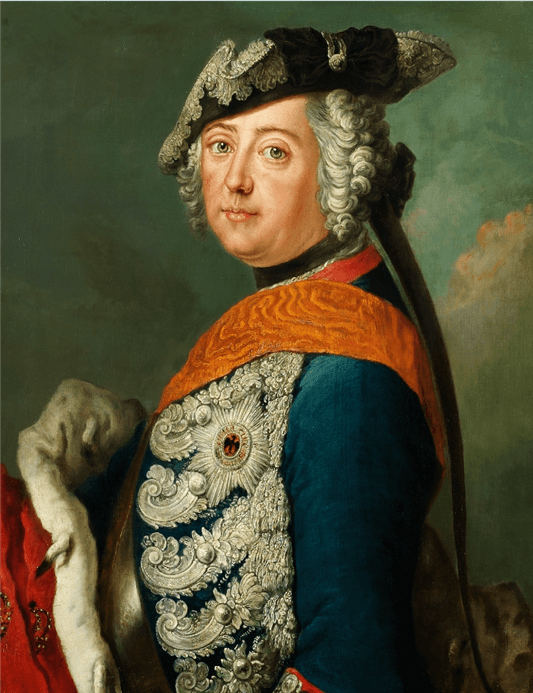
Frederick II of Prussia, known as Frederick the Great, played a major role in promoting mining and the metallurgical economy. In 1768, he brought copper shale mining in the Mansfeld region under sovereign control. In doing so, the Prussian state intervened directly in one of the most important ore-mining districts in central Germany. Copper, silver and other metals were of great importance for coinage, the military, administration and trade. Reforms of this kind helped consolidate Prussia’s position as a European great power.
Frederick grew up under a father who brutally enforced hardness, obedience and military masculinity. His father despised Frederick’s musical, artistic and literary interests and publicly humiliated his son. Even during Frederick’s lifetime, rumours about his relationships with men circulated at European courts. Frederick’s poems and letters contain clear homoerotic motifs. His relationship with Hans Hermann von Katte was especially close. In 1730, Frederick attempted to flee from his father with him. The plan failed. Katte was beheaded on the orders of Frederick William I, after a court martial had initially imposed a sentence of life imprisonment. Frederick was forced to watch the execution.
This experience shapes many interpretations of his later life. His marriage to Elisabeth Christine remained distant and childless. At the court of Sanssouci, Frederick lived largely apart from his wife; his closest personal bonds were with men. His circle included men such as Michael Gabriel Fredersdorf, Friedrich Rudolf von Rothenburg, Claude Étienne Darget and Francesco Algarotti. In letters, poems and contemporary accounts, closeness, desire, mockery, jealousy and erotic allusions appear, strongly indicating that Frederick desired men.
Portrait of king Frederick II.
workshop of Antoine Pesne
ca. 1750, oil on canvas
© Potsdam Museum – Forum für Kunst und Geschichte
photograph: Holger Vonderlind