
Money, money, money
Mining was a highly regulated economic sector in Tyrol as much as elsewhere. Miners were skilled workers, often highly specialised and in demand far beyond regional borders. Their knowledge of ore, drainage, tunnel construction, fire, wood, tools and work organisation was valuable to the mine owners. As "Bergwerksverwandte", people belonging to the mining community, they therefore stood in a special legal relationship. In many matters, they were not subject to the ordinary district courts, but to the mining judge.
Mining law primarily regulated the operation itself: work, ownership, wages, liability and order. It determined who was allowed to prospect where, how shares in mines were administered, what rights mine owners and miners had, and how conflicts in everyday mining life were to be handled. Questions of morality were scarcely addressed. The mining court held lower jurisdiction; serious offences had to be passed on to the district court. The district court, however, could not simply take action against members of the mining community on its own authority. First, any case had to be reported to the mining judge or taken up by him.
The mining judge’s main task was to ensure that operations in the mines continued. The focus was therefore on labour peace, dues, wages, debts, ownership questions, safety and supply. Reporting urgently needed workers because of private relationships or moral offences was hardly in the economic interest of the mine owners, as long as work, order and profit were not endangered. Proceedings could disrupt operations, remove skilled workers, create unrest and generate costs.
The records themselves follow this logic. What was written down was mainly what had to be administered, calculated, punished or decided in court. Relationships, desire and everyday closeness usually appear only when they became part of a dispute, debt, act of violence, inheritance question, insult to honour or public scandal. Everything else could have existed in daily life without leaving traces in accounts, regulations or court records.
If queer people are absent from mining records, this does not mean they did not exist. Relationships may not have been prosecuted, may not have been recognised, may have been handled informally or, in any case, were rarely written down. Absence of evidence is not evidence of absence.
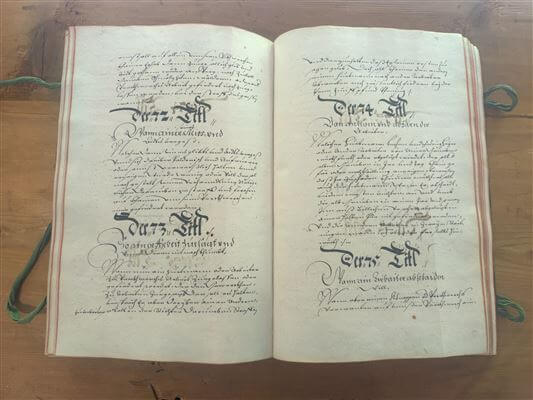
The Steinhauser Archiv holds numerous records for and about the mining judges of Taufers, including the Ferdinandean Mining Ordinance and a protocol of all matters brought before the mining judge Ramblmayr between 1689 and 1696.
The Ferdinandean Mining Ordinance was issued in 1553 under Ferdinand I and regulated mining in the Lower Austrian lands. Mining ordinances governed, among other things, the rights and duties of members of the mining community and supplemented existing mining law. They set out how mining operations were to be organised, supervised and legally regulated. The ordinance therefore also contains very concrete rules for everyday working life. These include what was to happen if someone broke their oath, failed to take up promised work, reported for work, left the mine after a shift or wished to leave service.
Manuscript bound as a book with the title „Nidterösterreichische Perckwerchs Ordnung“. It contains the Ferdinandean Mining Ordinance of 1553.
Steinhauser Archiv, 86.9