
Edward II of England
Edward II of England ruled a kingdom whose wars and struggles for power consumed enormous financial resources. The campaigns against Scotland, the conflict over royal authority and the tensions with France increased the need for coinage, weapons, equipment and administrative control. Mining formed part of this royal resource policy: silver and silver-bearing lead fed the monetary economy, while lead was needed for building, roofing, water pipes and military infrastructure. The silver and lead mines of Bere Ferrers in Devon had been under direct Crown administration since the reign of Edward I and continued to operate during Edward’s rule.
Some of these conflicts were closely connected to Edward’s relationships with men. Edward II was born in 1284 and became king of England in 1307. Even before this, his close relationship with Piers Gaveston had aroused suspicion at court. Gaveston was a nobleman from Gascony and had belonged to Edward’s closest circle since his youth. After his accession to the throne, Edward showered him with titles, lands and political influence. For many English barons, this was a provocation. They accused Gaveston of arrogance, abuse of power and an improper closeness to the king.
Contemporary chronicles write that the king loved Gaveston “beyond all mortals” and compared their relationship to that of David and Jonathan, whose love in the Old Testament is described as stronger than the love of women. Gaveston received honours, property and access to the king on a scale that was perceived at court as threatening.
Edward had been married since 1308 to Isabella of France, daughter of the French king Philip IV. The marriage was politically significant and produced four children, including the future Edward III. It was hardly a happy marriage, however. At the English court, Isabella often stood in the shadow of Edward’s favourites. Gaveston’s prominent position caused outrage as early as the coronation: he wore especially splendid clothing, walked directly before the king and was given a visibility that many saw as an insult to the young queen. Later, Isabella was repeatedly drawn into political decisions without ever being able to rely on real influence over her husband.
Gaveston was captured and executed by opposition nobles in 1312. Edward thereby lost the person to whom he was most closely attached. The conflict with the nobility did not settle as a result.
After Gaveston’s death, Hugh Despenser the Younger gained a similar position with the king. He too received lands, offices and direct access to Edward. Opponents again described the closeness between Edward and Despenser as an improper dependency. Despenser exploited his position ruthlessly. His family enriched itself, dispossessed opponents and became hated at court.
Isabella’s relationship with Edward deteriorated further during these years. In 1324, Edward deprived her of property, income and parts of her household, officially because of the war with France. In reality, she was increasingly isolated while Despenser gained ever greater power. In 1325, Isabella travelled to France to mediate in a conflict between England and France. She did not return to Edward’s court. Instead, she allied herself with Roger Mortimer, an opponent of the king and the Despensers. A political and personal relationship developed between Isabella and Mortimer, further weakening Edward.
In 1326, Isabella and Mortimer landed in England with a small army. Edward’s rule collapsed quickly. Many nobles changed sides, Hugh Despenser the Elder was executed, and Hugh Despenser the Younger was captured, publicly condemned and brutally killed. Edward fled, was captured and was forced to abdicate in early 1327. His son was made king as Edward III, while Isabella and Mortimer initially exercised real power.
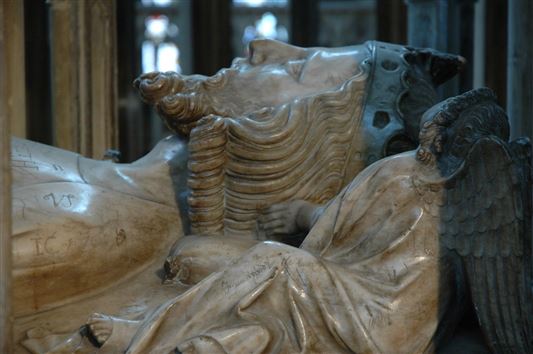
Edward died at Berkeley Castle in September 1327. The exact circumstances remain unclear. Later accounts tell of an especially cruel murder with a red-hot iron, but this version can only be traced later and is treated with caution by scholars. What is certain is that, after his deposition, Edward was regarded as a political risk. His tomb in Gloucester Cathedral soon became an important site of memory.
Detail of the tomb of Edward II
Gloucester Cathedral, England
photograph by Philip Halling
geograph.org.uk, SO8318 (CC BY-SA 2.0)