
Dark Ages?
Queerness in the Middle Ages
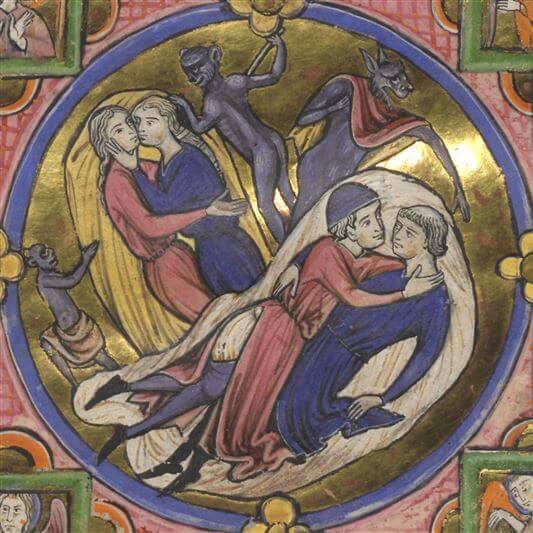
The Middle Ages were not as “dark” as they were later often described, and by no means as prudish as modern assumptions sometimes suggest. Sexuality was part of everyday life. It was discussed, regulated, confessed, punished and lived. Church norms, urban regulations and daily practice often differed considerably.
Modern terms for homosexuality did not yet exist. Instead, the concept of “sodomy” developed. This did not mean homosexuality in the modern sense. The term belonged to the doctrine of the "peccatum contra naturam", the “sin against nature”, and covered a wide range of sexual acts understood as deviations from procreation, marital order and the divine order of creation. A sin could be committed "ratione sexus", that is, “by reason of sex”. This included sexual acts between people of the same sex, especially between men. It could also be understood "ratione generis", i.e. “by reason of kind”, when people were accused of sexual acts with animals. And it could apply "ratione modi", “by reason of manner”, when sexual acts took place between a man and a woman, or alone, but were not directed exclusively towards procreation.
In the early Middle Ages, the main focus was usually penance. Church penitentials prescribed long periods of penance for sexual acts between men, but there was not yet systematic secular prosecution. The response was often pastoral and regulated by the Church: confession, remorse, fasting, prayer and temporary exclusion from certain religious acts. This changed gradually. From the 11th century, and especially from the 13th century onwards, attitudes became decidedly harsher. Church reforms, demands for clerical celibacy, preaching, canon law and urban legislation increasingly turned sin into crime. Depending on the region, punishments could include fines, public disgrace, banishment, castration or death.
Such transgressions were not regarded as purely private matters. In the medieval imagination, sexual sin could bring God’s wrath upon an entire community. Punishment was therefore directed not only at the individual, but was also meant to protect the family, village, town or territory from further misfortune. Epidemics, storms, famine and other disasters were repeatedly interpreted as consequences of moral wrongdoing. Even in the 14th century, locust plagues were linked to the allegedly immoral conduct of Margarete Maultasch, Countess of Tyrol. Accusations concerning sexuality were therefore also political tools. They could damage rule, dishonour opponents and impose social order.
Cod. 2254, fol. 2r (Ausschnitt), scenes from the Book of Genesis
1225-1249
Österreichische Nationalbibliothek, Wien, Cod. 2554, fol. 2r