
Mining = Women's work?
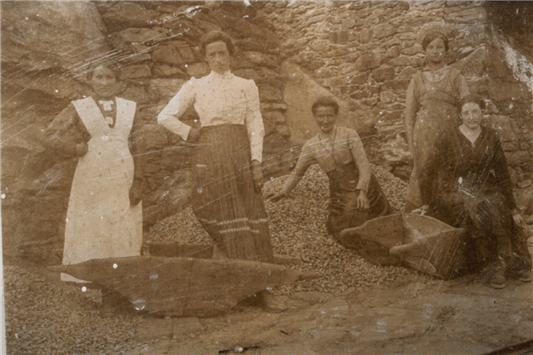
For centuries, mining regions were strongly male-dominated working environments. Despite this, women were active in mining, for example in separating, washing, sorting, carrying and supplying materials, or in related areas of work. In many regions, women also worked underground. Later, however, they were increasingly pushed out of actual extractive work. This exclusion was justified through ideas of physical weakness, the need for protection, moral concerns and superstition. In mining, the belief that women underground brought bad luck persisted for a long time. The only female figure allowed there was, paradoxically, Saint Barbara: not as a worker, but as the patron saint of miners.
Originally, women around the world worked side by side with men. At the Schneeberg, too, sorting the ores was women’s and children’s work. The women who separated the ore were known as "Tschodelen".
Initially, however, women also worked underground. The physically demanding labour in the tunnels, combined with a moral anxiety about women and men working together in dark underground spaces, led to a rigorous exclusion of women from the mining profession. In 1935, the International Labour Organization (ILO) even prohibited women from working underground.
Such prohibitions, however, say only so much about actual everyday practice. If mine owners were primarily concerned with yield, labour performance and the continued operation of the mine, the question arises of how strictly such boundaries were really controlled. From other historical working environments, we know that clothing was changed, names were adapted and legal rules were bypassed when work, wages or survival depended on it. Why should this have been fundamentally impossible in mining? Can we say with certainty that no woman ever worked underground in men’s clothing, especially in times of labour shortages, high demand or in remote mining districts? What means did supervisors have to monitor this permanently? And what economic interest would mine owners have had in rejecting capable workers as long as they performed their tasks?
These laws, intended as protective measures, also had negative consequences. Women were excluded from dangerous but lucrative work and, in many countries and regions, pushed into even more dangerous and far less protected forms of labour.
Where many unmarried men lived, or where men were separated from their families for long periods, forms of sex work often emerged. For many women in such places, prostitution was not a free choice, but part of a precarious economy of survival, shaped by poverty, limited opportunities for paid work and social exclusion. At the same time, the authorities reacted ambivalently: prostitution was tolerated or regulated on the one hand, and morally condemned and policed on the other.
Even today, women make up less than a quarter of the global mining workforce. The exclusion of women from mining work created an image of mining that, in most people’s minds, is almost exclusively male. The bioessentialist reduction of women to physical weakness and the associated need for special protection still contributes to structural gender inequality, both within mining and beyond it.
Tschodelen
South Tyrol Mining Museum, BM_0004242