
Not who, but how
Queerness in antiquity
Ancient societies did not share a single idea of “homosexuality” in the modern sense. Among Greeks, Romans, Etruscans and Egyptians, the main questions were roles, power relations, age, freedom or unfreedom (i.e. slave-status), and social status. What mattered was less whom a person desired than what position they occupied within the social order.
In the Greek world, relationships between men could be accepted in certain forms, especially between an adult citizen and a younger man. These relationships were linked to age, education, status and self-control. A free adult man was not supposed to appear subordinate, dependent or “female”. The passive or feminised role became especially problematic when it was attributed to a free adult man.
In Rome, this order was even more strongly shaped by status. A Roman man could have sexual contact with women or men without losing his social standing, as long as he appeared active, dominant and free. The passive partner, by contrast, was associated with femininity, dependence or slavery. This was considered particularly shameful for free adult men. Slaves, prostitutes and people of lower social status were judged differently, because their bodies were already regarded as available.
We know far less about Etruscan sexuality, because very few written sources from the Etruscans themselves have survived. Greek and Roman authors often described the Etruscans as especially permissive, particularly in relation to women, banquets, physicality and eroticism. Such accounts, however, were written from the outside looking in and were often polemical. What can be stated with more certainty is that Etruscan visual culture made bodies, couples and social spaces visible, without allowing simple conclusions about rules for same-sex relationships.
For ancient Egypt, the source situation is different again. Depictions of closeness between men, such as those of Nianchchnum and Chnumhotep, have been interpreted in very different ways by scholars: as brothers, twins, close companions or a possible couple. Egyptian sources also contain stories of same-sex acts among gods, for example between Seth and Horus. These texts, however, do not speak of identity, but of power, humiliation, rank and divine order.
Same-sex relationships in antiquity were therefore not necessarily taboo, as long as they did not threaten established patriarchal social standards. The “giving”, physically active partner was considered less problematic, provided that he did not call his masculine, free and socially superior role into question. The “receiving”, physically passive partner, by contrast, was feminised and therefore exposed to much greater social disapproval, especially if he was a free adult man.
Other ancient and premodern societies also knew gendered roles beyond a simple binary division. In Mesopotamian texts connected with the goddess Inanna or Ishtar, cultic figures such as gala, assinnu or kurgarru appear. They could be associated with gender ambiguity, ritual, lamentation, disguise and divine power. Their position was framed by religion and socially distinctive, but not automatically equal or free from devaluation.
In South Asia, too, Hijras or Khawaja Sira have long been known as communities often described as a “third gender”. They perform ritual roles, for example at births, weddings and blessings, while at the same time often standing at the margins of the social order.
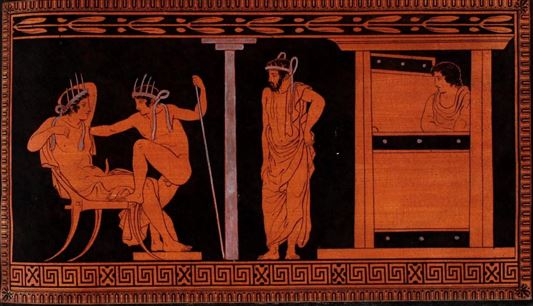
Eroctic scnee between male youths. Coloured print plate after an Attic red-figure bell krater by the Dinos Painter, around 420 BC, found in Capua. From the collection of William Hamilton, now in the British Museum.
From: Collection of Etruscan, Greek and Roman Antiquities from the Cabinet of William Hamilton, Bd. 2, Naples, 1767.
Scan: Internet Archive / Boston Public Librar
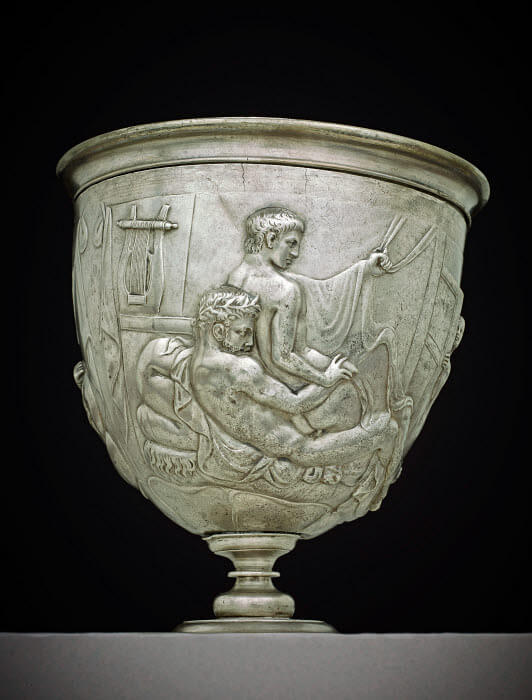
The Warren Cup is a Roman silver drinking cup, made around the turn of the era, roughly between 15 BC and AD 15. The cup originally had two handles, which are now lost. It consists of an inner drinking vessel and a thinner outer casing, into which two erotic scenes were worked in high relief. Details were added by engraving, and individual areas were originally gilded. Today, the cup is held by the British Museum.
Both sides show sexual scenes between male figures in an interior with fabric hangings, furniture and musical instruments. On one side, an older bearded man wearing a wreath is shown as the active lover; his younger partner is beardless. On the other side, the active partner is himself a beardless young man, while the receiving partner is shown as a boy. Another figure looks into the room through a doorway and is usually interpreted as a slave.
The cup was not an everyday drinking cup, but a precious luxury object. Its careful workmanship, interior scenes and musical references point to an educated, wealthy and Hellenised elite culture. It was probably made in the eastern Mediterranean. The British Museum gives the findspot as probably Bittir near Jerusalem. Its present name derives from the collector Edward Perry Warren, who owned the cup in the early 20th century.
After Warren’s death, the cup long remained in private ownership. Its explicit homoerotic scenes made public display and sale to museums difficult. Only as social attitudes changed was the object more widely exhibited. In 1999, the British Museum acquired the Warren Cup and made it permanently accessible to the public.
Silver drinking cup
15 BC - AD 15.
Made in the Levant, findspot: Jerusalem
British Museum, 00594242001