
Wild West
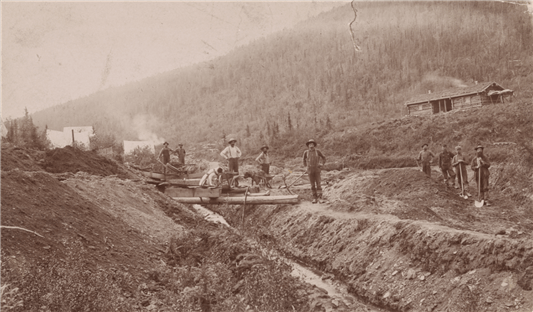
The California Gold Rush began in 1848. In Coloma, on the South Fork of the American River, James W. Marshall found gold on 24 January. The site lies in present-day El Dorado County, whose name refers to the older legend of the gilded land. Consequently, hundreds of thousands of people moved west within a short time, and numerous camps, settlements and mining sites emerged. Many lasted only a few weeks or months, while others developed into permanent towns.
The mining districts were overwhelmingly male. In 1850, California was described as having roughly twelve men for every woman. In some places, men made up as much as 97 percent of the population. Where women were almost entirely absent, men had to organise domestic life, work and companionship among themselves.
At the same time, many of the institutions that elsewhere monitored morality and sexuality were absent from the early camps. State courts, established church communities and bourgeois family structures only gradually took hold. This created room for gender-crossing practices and intimate relationships between men.
Letters, diaries and travel accounts describe male households, shared sleeping places, care work, cooking, washing and sewing. At festivities, men danced with one another; some explicitly took on “ladies’ roles”. These freedoms later became more restricted as towns, authorities, parishes, families, moral reform groups and newspapers gained influence.
Gold miners in El Dorado, Calfornia.
1848-1853
Library of Congress Prints and Photographs Division Washington, D.C.; LC-DIG-ds-04487