
Man enough?
The connection between queer history and feminism
The history of queerness is also a history of feminism. Both perspectives ask how societies represent, value and control gender. At the centre are not only men and women as categories, but also the qualities associated with gender: strength or weakness, reason or emotion, work or care, public life or domesticity. Such attributions are never neutral. They assign a particular place to bodies, activities and ways of life.
For queer history, the concept of feminisation is especially important. In many patriarchal societies, “female” was understood not only as a gender category, but also as a sign of social subordination. Anyone marked as passive, dependent, sensitive, physically weaker or sexually available could be devalued. This affected women directly, but also men who were considered “unmanly”, whether because of their desire, clothing, work, behaviour or social position.
In premodern and modern orders, masculinity was often associated with self-control, property, military capacity, public authority and physical performance. Deviations from this could appear as moral, social or legal problems. Same-sex desire between men was therefore often read not only as a sexual act, but also as a violation of masculine order. The passive or female-coded role in particular was devalued, because it was associated with subordination.
Same-sex relationnships between women, by contrast, remained unnoticed for longer in many legal and moral systems, or were prosecuted less frequently and less severely. This did not mean greater freedom. It often reflected the fact that female sexuality was only partially recognised as an independent and active sexuality.
Feminist research examines precisely these hierarchies. Why are certain activities, bodies and forms of dependence considered inferior? Who is described as rational, capable of work, entitled to authority or in need of protection? Queer history extends these questions to desire, bodily presentation and social legibility. It asks how people were forced into categories they had not chosen themselves, and how they nevertheless found room for action.
Queerness and feminism intersect in the questions they ask: Who is allowed to work? Who is allowed to love? Who is allowed to be visible? Whose body is considered productive, vulnerable or dangerous? And who decides which lives are considered “normal”?
For queer history, the concept of feminisation is especially important. In many patriarchal societies, “female” was understood not only as a gender category, but also as a sign of social subordination. Anyone marked as passive, dependent, sensitive, physically weaker or sexually available could be devalued. This affected women directly, but also men who were considered “unmanly”, whether because of their desire, clothing, work, behaviour or social position.
In premodern and modern orders, masculinity was often associated with self-control, property, military capacity, public authority and physical performance. Deviations from this could appear as moral, social or legal problems. Same-sex desire between men was therefore often read not only as a sexual act, but also as a violation of masculine order. The passive or female-coded role in particular was devalued, because it was associated with subordination.
Same-sex relationnships between women, by contrast, remained unnoticed for longer in many legal and moral systems, or were prosecuted less frequently and less severely. This did not mean greater freedom. It often reflected the fact that female sexuality was only partially recognised as an independent and active sexuality.
Feminist research examines precisely these hierarchies. Why are certain activities, bodies and forms of dependence considered inferior? Who is described as rational, capable of work, entitled to authority or in need of protection? Queer history extends these questions to desire, bodily presentation and social legibility. It asks how people were forced into categories they had not chosen themselves, and how they nevertheless found room for action.
Queerness and feminism intersect in the questions they ask: Who is allowed to work? Who is allowed to love? Who is allowed to be visible? Whose body is considered productive, vulnerable or dangerous? And who decides which lives are considered “normal”?
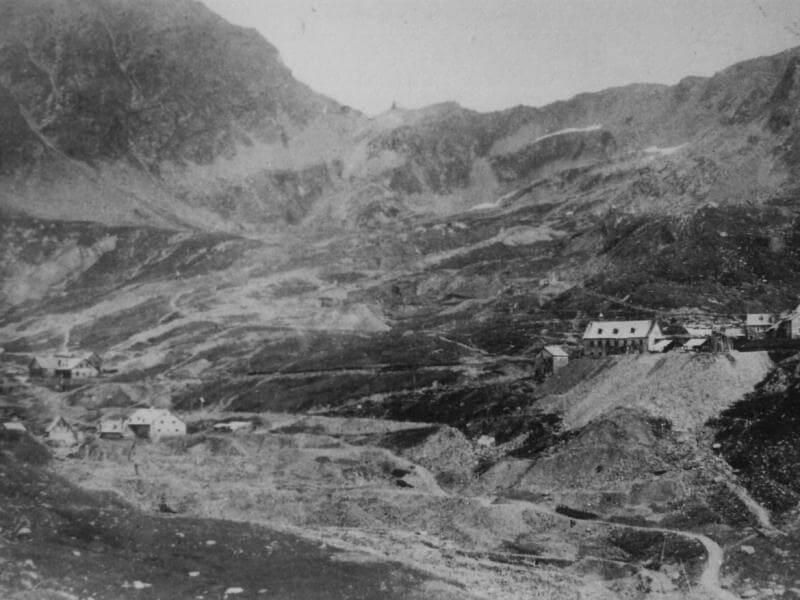
Women's house
On the Schneeberg, women lived separately from the men in the so-called “women’s house”. It stood about 400 metres away from the main settlement. The woman in charge of the women’s house, usually an older woman, was known as the “Hutmannin”.
The women's house on the Schneeberg, on the far left of the image
South Tyrol Mining Museum, BM_ 0004240
The women's house on the Schneeberg, on the far left of the image
South Tyrol Mining Museum, BM_ 0004240