
Dancing in the Dark
Historical lives cannot be described seamlessly with the terms we use today. It would therefore be inaccurate simply to impose present-day categories on the past. It would be just as inaccurate, however, to assume that queer realities did not exist because those categories were not yet available. Queer history examines not only identities, but also actions, desires and social practices. It asks where historical closeness was read as “friendship”, and where queer life therefore remained invisible.
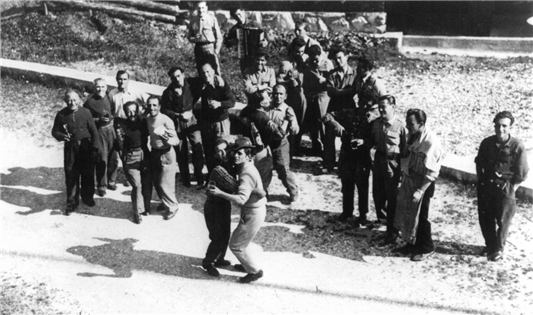
Many men lived and worked for long periods in isolated mining districts, far from families and village control, in close communities shaped by strong mutual dependence. Photographs from the Schneeberg show miners dancing together and in forms of physical closeness that today at least raise questions about emotional and bodily relationships. The recollection of the geologist Paolo Acquaroni is especially revealing: he described homosexual relationships among young miners at Schneeberg as “certamente presente”, that is, clearly present, normal and at the same time an open secret.
However we read historical sources, one thing is obvious: our present is diverse. Queer people live, work, love and struggle in all societies, professions and generations. They are not a marginal phenomenon or an exception, but part of social reality.
Moreover, labour movements and LGBTQ+ movements have not always been separate from one another. Both have fought, and continue to fight, against exclusion, insecurity and the denial of dignity. Where people are devalued because of origin, work, body or love, similar experiences arise, and with them the possibility of shared solidarity.
A person’s lived reality does not have to be fully understood in order to be respected. A democratic society defends rights even where individual experience ends. Diversity is also not a purely European issue. Many cultures have their own forms of gender and sexual diversity. Pride recalls past struggles and insists that visibility, safety and equal dignity remain matters of public responsibility.
Miners dancing together at the Schneeberg.
South Tyrol Mining Museum, BM_0004241