
The stars
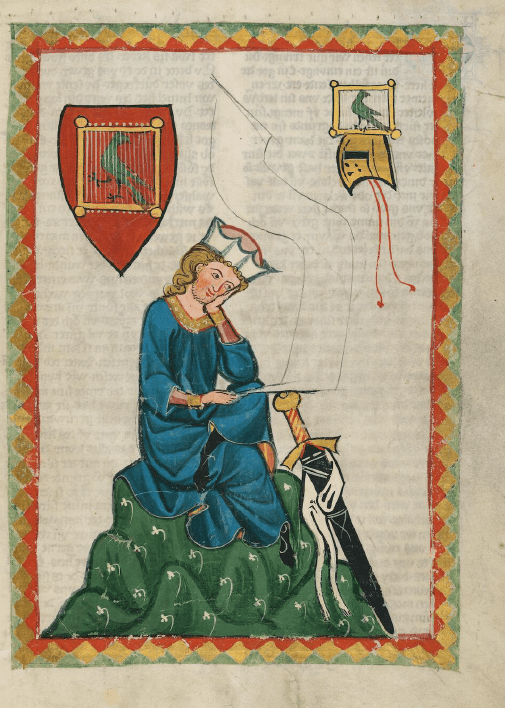
Walther von der Vogelweide
Walther von der Vogelweide, born around 1170 and deceased around 1230, is regarded as one of the most important German-language poets of the Middle Ages. His origins remain uncertain, although several indications point to the South Tyrolean region. Walther was active at various courts and depended on the support of aristocratic patrons. In his Minnelieder he explored different forms of love, while in his Sangsprüche he commented on political, religious and social conflicts. He was also a political thinker who used his songs as incisive commentary on imperial politics. His melodies were known throughout the German-speaking world.
Miniature of Walther von der Vogelweide from the Codex Manesse
Universitätsbibliothek Heidelberg, Cod. Pal. germ. 848
Große Heidelberger Liederhandschrift (Codex Manesse)
Zurich, c. 1300 -c. 1340
Miniature of Walther von der Vogelweide from the Codex Manesse
Universitätsbibliothek Heidelberg, Cod. Pal. germ. 848
Große Heidelberger Liederhandschrift (Codex Manesse)
Zurich, c. 1300 -c. 1340

On 12 November 1203, Walther von der Vogelweide received five solidi for a fur garment. The entry in the account book of Bishop Wolfger von Erla is the only documentary evidence of his life.
Travel records of Wolfger von Erla Ellenbrechtskirchen
1204
Fondo Archivio Storico del Comune di Cividale del Friuli, Foglio n. 11v
Travel records of Wolfger von Erla Ellenbrechtskirchen
1204
Fondo Archivio Storico del Comune di Cividale del Friuli, Foglio n. 11v
Unter der Linden
Under the linden tree
"Under der linden"
Ensemble Tempus
In “Unter der linden”, a young woman recounts a secret meeting with her lover. In a meadow beneath a linden tree, she spent the night with him. Crushed grass and flowers continue to reveal the place of their encounter.
With the concept known as ebene Minne, Walther von der Vogelweide developed his own idea of love between Hohe Minne and Niedere Minne. It was to consist neither in the unfulfilled adoration of a woman of higher social rank nor in mere physical desire. What mattered was reciprocity. Man and woman were to love one another and turn to each other freely.
“Unter der linden” comes particularly close to this ideal. The woman herself speaks of kisses, physical intimacy and her joy in the night they spent together. Only the nightingale was a witness. Its “tandaradei” accompanies her memory of the secret encounter.
| Under der linden an der heide, dâ unser zweier bette was, Dâ muget ir vinden schône beide gebrochen bluomen unde gras. Vor dem walde in einem tal, tandaradei, schône sanc diu nahtegal. Ich kam gegangen zuo der ouwe: dô was mîn friedel komen ê. Dâ wart ich empfangen, hêre frouwe, daz ich bin saelic iemer mê. Kuster mich? wol tûsentstunt: tandaradei, seht wie rôt mir ist der munt. Dô het er gemachet alsô rîche von bluomen eine bettestat. Des wirt noch gelachet inneclîche, kumt iemen an daz selbe pfat. Bî den rôsen er wol mac, tandaradei, merken wâ mirz houbet lac. Daz er bî mir laege, wessez iemen (nu enwelle got!), sô schamt ich mich. Wes er mit mir pflaege, niemer niemen bevinde daz, wan er und ich. Und ein kleinez vogellîn: tandaradei, daz mac wol getriuwe sîn. |
Under the linden tree on the heath, where the two of us had made our bed, there you may find together broken flowers and grass. Before the forest, in a valley, tandaradei, sweetly sang the nightingale. I came walking to the meadow: my lover had arrived before me. There I was welcomed, noble lady, so that I shall be happy evermore. Did he kiss me? A thousand times: tandaradei, see how red my mouth is. He had made so splendidly a bed of flowers. Whoever comes along that same path will still smile at the sight. Among the roses one may well, tandaradei, see where my head had lain. If anyone knew that he lay beside me (God forbid!), I would be ashamed. But what he did with me may no one ever discover, except for him and me. And one little bird: tandaradei, that one can surely keep our secret. |
Nu al rest
Palestine Song
"Nu al rest"
Ensemble Tempus
“Nu alrest lebe ich mir werde”, today generally known as the “Palästinalied” or “Palestine Song”, is one of Walther von der Vogelweide’s best-known works. It was probably composed in the 1220s in the context of the Crusades. Whether it was directly connected with Emperor Frederick II’s crusade of 1228/29 cannot be established with certainty.
The song is written from the perspective of a pilgrim or crusader who has reached the Holy Land. He now sees with his own eyes the places where, according to Christian tradition, Christ was born, lived, died and rose again. From this, Walther develops a history of the land from the perspective of Christian salvation history. The claims of Christians, Jews and Muslims are also addressed, while the text argues for the Christian claim to the Holy Land.
It is the only one of Walther’s works whose melody has survived in full. The melody, however, is preserved only in the 14th-century Münster Fragment, around a hundred years after Walther’s lifetime. It therefore remains uncertain whether this melody corresponds exactly to the version sung during his lifetime.
| Nû alrêst lebe ich mir werde, sît mîn sündic ouge siht daz hêre lant und och die erde, dem man vil der êren giht. Mirst geschehen, des ich ie bat, ich bin komen an die stat, dâ got menschlîchen trat. Schœne lant, rîch unde hêre, swaz ich der noch hân gesehen, sô bist dûz ir aller êre, waz ist wunders hie geschehen: Daz ein maget ein kint gebar, hêre uber aller engel schar, was daz niht ein wunder gar? Hie liez er sich reine toufen, daz der mensche reine sî. dô liez er sich hie verkoufen, daz wir eigen wurden vrî. Anders wæren wir verlorn. wol dir sper, cruze unde dorn! wê dir, heiden! daz ist dir zorn. Dô er sich wolte über uns erbarmen, hie leit er den grimmen tôt, er vil rîche über uns vil armen, daz wir komen ûz der nôt. Daz in dô des niht verdrôz, daz ist ein wunder alze grôz, aller wunder übergenôz. Hinnen vuor der sun zer helle, von dem grabe, dâ er inne lac. des was ie der vater geselle, und der geist, den nieman mac Sunder gescheiden, dêst al ein, sleht unde ebener danne ein zein, alse er Abrahâm erschein. Dô er den tievel dô geschande, daz nie keiser baz gestreit, dô vuor er her wider ze lande. dô huob sich der juden leit, Daz er hêrre huote brach, und daz man in sît lebendic sach, den ir hant sluoc unde stach. Dar nâch was er in deme lande vierzic tage, dô fuor er dar, dannen in sîn vater sande. sînen geist er uns bewar, Den sant er hin wider zehant. heilic ist daz selbe lant, sîn name, der ist vor got erkant. In diz lant hât er gesprochen einen angeslîchen tac, dâ die witwe wirt gerochen und der arme clagen mac Und der weise den gewalt, der dâ wirt an ime gestalt: wol ime dort, der hie vergalt. Unserre lantrehtære tihten fristet dâ niemannes clage, wan er wil dâ zestunt rihten: sô ist ez an dem lesten tage. Und swer deheine schulde hie hât unverebenet, wie der stât dort, dâ er pfant noch bürgen hât. Juden, Cristen unde heiden jehent, daz diz ir erbe sî. got sol uns ze reht bescheiden dur die sîne namen drî. Al diu welt, diu strîtet her: wir sîn an der rehten ger, reht ist, daz er uns wer. Irlât iuch nit verdriezen, daz ich noch gesprochen hân. sô wil ich die rede entsliezen kurzwîlen und ouch wizzen lân, Swaz got wunders hie noch lie, mit der welte ie begie, daz huob sich dort und endet hie. |
Only now does my life gain worth, since my sinful eyes behold the glorious land and also the soil to which so much honour is given. What I always prayed for has come to pass: I have reached the place where God walked as a man. Beautiful land, rich and noble, of all the lands that I have seen, you are the most glorious. What wonders have happened here: a virgin gave birth to a child, Lord above all the hosts of angels. Was that not a wondrous thing indeed? Here he let himself be baptised in purity, so that humankind might be made pure. Then here he let himself be sold, so that we, who were enslaved, might become free. Otherwise we would have been lost. Blessed be the spear, the cross and the thorns! Woe to you, heathen: this is cause for your anger. When he chose to have mercy on us, here he suffered cruel death, he, so mighty, for us so wretched, so that we might be delivered from our distress. That he did not shrink from this is a wonder so great that it surpasses every other wonder. From here the Son descended into Hell, from the tomb in which he lay. The Father was always with him, and the Spirit, whom no one can separate from them: they are all one, undivided and perfectly united, as he appeared to Abraham. After he had defeated and humbled the Devil, as no emperor ever fought better, he returned again to this land. Then began the sorrow of the Jews, because he broke through the guard and was afterwards seen alive, he whom their hands had killed and pierced. Afterwards he remained in this land for forty days, and then departed to where his Father had sent him from. May he preserve his Spirit for us, whom he then sent back to us. Holy is this land, and its name is known before God. In this land he has proclaimed a dreadful day, when the widow shall be avenged and the poor man may bring his complaint, and the orphan may speak of the violence that has been done to him: blessed there is he who made amends here. Our earthly judges may delay legal claims, but there no complaint will be postponed, for he will judge at once: so it shall be on the Last Day. And whoever leaves any debt here unsettled, how will he fare there, where he has neither pledge nor guarantor? Jews, Christians and heathens all claim that this land is their inheritance. May God decide between us justly by his three names. All the world contends for this land: ours is the rightful claim, and it is right that he grant it to us. Do not be displeased that I still have more to say. I shall continue the tale, both to entertain and to impart knowledge, of all the wonders that God has worked here and in the world: what began there finds its fulfilment here. |

Oswald von Wolkenstein
Oswald von Wolkenstein, born in 1377 at Schöneck Castle in the Puster Valley and deceased in Merano in 1445, marks the transition from traditional Minnesang to new musical forms. His songs broke with the rigid conventions of courtly poetry and spoke openly of drinking bouts, harsh prison sentences, heated marital disputes and the pain of growing old. He made himself the central figure of his own music.
As a diplomat, he encountered polyphonic music in France and Italy and incorporated its techniques into his own repertoire. Oswald had his works collected in two richly decorated manuscripts. As a result, numerous texts and melodies have survived.
Portrait of Oswald von Wolkenstein in manuscript “B” of his songs
1432
University and Regional Library of Tyrol
Photo: Watzek Photografie, Hall in Tirol
As a diplomat, he encountered polyphonic music in France and Italy and incorporated its techniques into his own repertoire. Oswald had his works collected in two richly decorated manuscripts. As a result, numerous texts and melodies have survived.
Portrait of Oswald von Wolkenstein in manuscript “B” of his songs
1432
University and Regional Library of Tyrol
Photo: Watzek Photografie, Hall in Tirol
Frölich zärtlich lieplich und klärlich
Joyful, tender, lovely and clear
"Frölich zärtlich lieplich und klärlich"
Ensemble Tempus
Oswald von Wolkenstein’s song “Frölich zärtlich lieplich und klärlich” (Kl. 53 according to Karl Kurt Klein) begins like a dawn song. Morning breaks and the woman is called to wake. In the traditional dawn song, this moment usually marks the end of a night of love: with daylight, the lovers must part. Oswald takes a different course. The woman is to rise and come to the dance, and the morning wake-up call develops into an increasingly erotic song.
In the second stanza, Oswald turns his attention to his beloved’s mouth and strings together unusual coinages such as “lunzlocht”, “munzlocht” and “wisplocht”. Some of these words can no longer be translated with certainty today. What matters above all is their sound, evoking whispering, caressing and kissing. In the final stanza, the description becomes unmistakably physical. Oswald longs for bodily closeness, mouth to mouth, tongue to tongue, breast to breast and belly to belly.
Oswald reworked the French rondeau “En tes doulz flans” as a contrafactum, using the original 14th-century melody for his own German text.
| Frölich, zärtlich, lieplich und klärlich lustlich, stille, leise, in senfter, süesser, keuscher, sainer weise wach, du minnikliches, schönes weib, reck, streck, preis dein zarten, stolzen leib! Sleuss auff dein vil liechte euglin klar! taugenlich nim war, wie sich verschart der sterne gart in der schönen, haitern, klaren sunnen glanz! wolauff zue dem tanz! machen ainen schönen kranz von schaunen, praunen, plawen, grawen, gel, rot, weiss, viol plüemlin spranz. Lunzlocht, munzlocht, klunzlocht und zisplocht, wisplocht, freuntlich sprachen auss waidelichen, gueten, rainen sachen sol dein pöschelochter, roter munt, der ser mein herz tiefflich hat erzunt Und mich fürwar tausent mal erweckt, freuntlichen erschreckt auss slaffes traum, so ich ergaum ain so wolgezierte, rote, enge spalt, lächerlich gestalt, zendlin weiss darin gezalt, trielisch, mielisch, vöslocht, röslocht, hel zu fleiss waidelich gemalt. Wolt si, solt si, tät si und käm si, näm si meinem herzen den senikleichen, grossen, herten smerzen, und ain prüstlin weiss darauff gesmuckt, secht, slecht wär mein trauren da verruckt. Wie möcht ain zart seuberliche diern tröstlicher geziern das herze mein an allen pein mit so wunniklichem, lieben rainen lust? mund mündlin gekust, zung an zünglin, prüstlin an prust, pauch an peuchlin, rauch an reuchlin snell zu fleiss allzeit frisch getust. |
Joyful, tender, lovely and clear, graceful, quiet and soft, in a gentle, sweet, chaste and languid way, awake, you dear and beautiful woman, rise, stretch, show your tender, splendid body! Open your bright little eyes so clear! Secretly take note of how the garden of stars fades away in the radiance of the lovely, cheerful, shining sun. Come now to the dance! Let us weave a fair garland glowing with little flowers brown, blue, grey, yellow, red, white and violet. Softly opening, coaxing, lisping, whispering and murmuring in sweet tongues of delightful, good and pure things, such should be your full red mouth, which has so sweetly set my heart aflame and in truth has woken me a thousand times already, gently rousing me from the dream of sleep, whenever I beheld so well-shaped, red and narrow a cleft, in the form of a smile, with little white teeth set within. Lips sip delicately, precious and rosy, and seem so bright, wonderfully painted. If she would, if she should, if she came and took from my heart the great, hard pains of longing, and a little white breast were pressed thereupon, see, then my sorrow would quickly be driven away. How could a tender, lovely maiden more joyfully adorn my heart, without grievous pain, with such blissful, tender and pure delight? Mouth to little mouth kissed, tongue to little tongue, little breast to breast, belly to little belly, bush to little bush, swiftly, with ardour, pressed together in lively eagerness. |
Grasselik lif
Lovely beloved
"Grasselik lif"
Ensemble Tempus
With “Grasselick lif” (Kl 96), Oswald von Wolkenstein composed a love song in a language intended to sound Dutch or Flemish. The text does not consistently reproduce any single language. Low German, Dutch and Upper German forms appear side by side.
The title itself was long misunderstood. Here, “Grasselick” has nothing to do with the modern German word “grässlich”, meaning “horrible”, but probably derives from Middle Dutch “gracelijc” or “graselijc”, meaning “lovely” or “graceful”. The song therefore opens with an address to a beloved woman. After a long separation, the lovers are reunited. They assure each other of their affection and express the wish to belong only to one another.
| Grasselick lif, war hef ick dick verloren all dise lange, sütten summertit? Dat gi mi komt tu vorn, so left min hert in grot jolit. Geilicken fro, all telich sunder truren tüt jo frowen lan einig minen lif! Dat gschol ick nit verluren, mit willen gschin dein einig wif. Freuntlicker gschat, dat slot müt gschin verbunden und so keiserlick wol verrigelt sir. Erst hef ick freude funden, und welt min hert kain andern mier |
Lovely beloved, where had you been lost to me all through this long, sweet summer? Now that you stand before me once again, my heart is filled with great joy. Joyfully and free from all sorrow, let me bring joy to you alone, my love! I will not give this up: of my own free will, I wish to be yours alone. Dearest treasure, let the castle be closed and firmly and securely locked. Only now have I found joy, and my heart desires no other. |
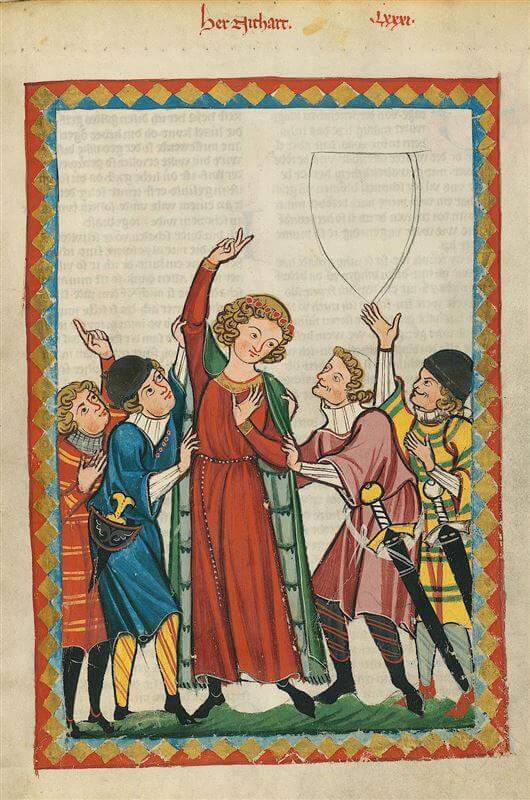
Neidhart von Reuental
Neidhart was active in the first half of the 13th century, initially in Bavaria and later probably in Austria. Very little is known about his life. The influence of his songs, however, was considerable: centuries later, they were still being copied, sung and further developed under his name.
Neidhart adopted the forms and language of courtly Minnesang, but often shifted the setting to the countryside. There, young peasant men appear in fashionable clothing, dancing, courting women, quarrelling and fighting. The singer himself, as a lover, repeatedly comes into conflict with them. In this way, the courtly world and its rules are confronted with a deliberately coarse and unruly counterworld.
Herr Neidhart
Heidelberg, Universitätsbibliothek Heidelberg, Cod. Pal. germ. 848
Große Heidelberger Liederhandschrift (Codex Manesse)
Zurich, c. 1300 -c. 1340
Neidhart adopted the forms and language of courtly Minnesang, but often shifted the setting to the countryside. There, young peasant men appear in fashionable clothing, dancing, courting women, quarrelling and fighting. The singer himself, as a lover, repeatedly comes into conflict with them. In this way, the courtly world and its rules are confronted with a deliberately coarse and unruly counterworld.
Herr Neidhart
Heidelberg, Universitätsbibliothek Heidelberg, Cod. Pal. germ. 848
Große Heidelberger Liederhandschrift (Codex Manesse)
Zurich, c. 1300 -c. 1340
Winder, dîniu meil
Winter your marks
"Winder, dîniu meil"
Ensemble Tempus
“Winder, dîniu meil” belongs to Neidhart’s winter songs. From the very beginning, the season is associated with loss: the signs of winter destroy the woods, flowers and heath, and the joys of summer have passed. Neidhart follows this lament for winter with one of his own. He has long served a woman in love, yet his courtly devotion remains without the reward he hopes for. Even his faithfulness seems unable to change this.
As so often in Neidhart’s songs, however, the poem does not remain a courtly lament of love. Young peasant men appear as rivals for the woman, are named individually, mocked and threatened. Engelmâr, Erphe, Adelwin and other “Dörper”, coarse and uncouth villagers, make life difficult for the singer. One of them has even torn a mirror from a woman’s side. The singer meanwhile describes his own hair as white as ice. He claims that it is not age alone that has turned him grey, but his repeated defeats in love and rivalry.
This shift between Minnesang and the coarse world of the village is characteristic of Neidhart’s songs. The courtly conventions of love remain recognisable, but they are confronted with jealousy, mockery, quarrels and explicit threats of violence.
| Winder, dîniu meil diu verderbent uns den walt, die bluomen und die heide sam. Sumer, dîn gesinde ist allez worden vreudenlôs. Manic herze geil hât ze trûren sich gestalt, den allen vreude wol gezam. Wie zimt einem wîbe, diech vür elliu wîp erkôs, daz si nie mir vervie mînen sanc ze guote, den ich ir mit dienste willeclîchen sanc unde stên noch hiute in mîner huote, daz si an mîner staete nindert vindet dwerhen schranc? Sol mîn staetikeit und der lange dienest mîn erwerben niht wan ir versagen, sô muoz mich von schulden riuwen, daz ichs ie began. Mirst iedoch geseit, die da staete kunnen sîn, daz si gelücke wol bejagen. Vrouwe Saelde, ûf dînen trôst ich noch die guoten man, daz si ir strît unde ir nît gein ir vriunden lâze. Tuot si daz, sô wirt daz ende lîhte guot. Schaffe ir ungenâden eine mâze! Wê, daz immer wîp an guoten vriunden missetuot! Von der staete mîn bin ich nîdes überladen. Nu hœret, vriunde, mîne klage! Râtes unde lêre der bedorfte ich nie sô wol. Erphe und Adelwin tuont mir ungedienet schaden, daz eltet mich ê mîner tage. Niemen sol des wænen, deichz mit guotem willen dol. Ditze jâr sunderbâr wurbens umbe ir minne, diu mir hiute und immer ist vür elliu wîp. Vrouwe, mînes herzen küneginne, du solt nimmer man getrœsten vür mîn eines lîp. Dîner ôren tür müezen dir verslozzen sîn, dazs immer iht von in vernemen, die mîn wider dich gedenken anders danne wol! Ô lâ die rede vür, herzenliebiu vrouwe mîn, die dir ze hœren niht gezemen! Solher lêr man guoten vriunden gerne volgen sol. Künebreht, Engekneht, zwêne tozelaere, muotent dîner êren: vrouwe, den versage! Daz ist mînes lieben herzen swære, der ich tougenlîche vil in mînem herzen trage. Schouwet an mîn hâr, daz gevar ist als ein îs! Daz grâwet mir, des ist niht rât, wande mir von getelingen niwan leit geschach. Jener Engelmâr, von des schulden bin ich grîs, der hiute noch den spiegel hât, den er dörper Vriderûnen von der sîten brach. Von der zît immer sît warp ich nimmer mêre, ich enhiete ein iedeniuwez herzenleit. Daz ist mînes leiden herzen sêre von der liebe, die mîn herze sînem liebe treit. Von hinnen unz an den Rîn, von der Elbe unz an den Phât, diu lant diu sint mir elliu kunt: diu enhabent niht sô manegen hiuzen dorefman, als ein kreizelîn wol in Oesterrîche hât; dâ ist inne manic niuwer vunt. Seht, daz prüevet einer, der mir lützel guotes gan! Wankelbolt, selten holt was er mir mit triuwen. Er ist scharemeister in dem Lugetal: daz mac jenen gouch vil wol geriuwen. Kumt er mir ze râme, ich dürkel im die hirneschal. Bî dem Lugebach ener mit gewalte vert: er wænet in den lüften sweben. Sîne triuwe habent aberhâken als ein ger. Michel ungemach was mir ie von im beschert; daz ist im noch vil unvergeben: daz beweinent viere und dar zuo etelîcher mêr. Lachent an er den man snîdet mit der zungen. Wê der muoter, diu in mir ze schaden truoc! Nû bin ich beswæret von dem jungen, daz ich hân von sînen schulden nindert genden phluoc. Liebe mir geschach: wær diu liebe alsô beliben! Ich kom, dâ ich vil rôsen vant. Seht, der brach ich eine! Diu wart schiere dô verlorn. Leit und ungemach hât mir vreude vil vertriben. Ich sage iu, waz mir wart bekant: dô ich si brach, dô tet mir wê ein ungevüeger dorn, daz ich vil gewisse enwil nimmer rôsen brechen, ichne sehe, ob iz der rehten einiu sî. Sumelîche rôsen kunnen stechen, rehte rôsen die sint aller wandelunge vrî. |
Winter, your marks are ruining the woods for us, the flowers and the heath as well. Summer, all your retinue has lost its joy. Many a cheerful heart has turned to sorrow, though joy suited them so well. How can it become a woman, whom I chose above all women, never to have received with favour the song that I willingly sang to her in service? And even today I remain on my guard, so that in my constancy she may find no deviation. If my constancy and my long service earn nothing but her refusal, then I have good reason to regret that I ever began. Yet I have been told that those who know how to remain steadfast may indeed gain good fortune. Lady Fortune, I still place my trust in you: may she abandon her hostility and resentment towards her friends. If she does, the end may yet be good. Set a limit to her harshness! Alas that a woman should ever wrong good friends! My constancy has brought envy down upon me. Now hear my complaint, friends! Never have I been in greater need of counsel and guidance. Erphe and Adelwin do me undeserved harm, and it ages me before my time. Let no one imagine that I endure it willingly. This year in particular they have courted her love, she whom today and forever I place above all women. Lady, queen of my heart, give comfort to no man but me alone. May the doors of your ears remain closed, so that you never listen to those who speak ill of me before you! Pay no heed to such words, my dearly beloved lady, for they are not fit for you to hear. Good advice from friends should gladly be followed. Künebreht and Engekneht, two jesters, seek your favour: lady, refuse them! This weighs heavily on my loving heart, a sorrow I secretly bear within me. Look at my hair, white as ice! It is turning grey, and there is no remedy, for from my rivals I have received nothing but sorrow. That Engelmâr, because of whom I have grown grey, still possesses the mirror which, boor that he is, he tore from Friderûn’s side. Ever since that day, whenever I have courted, I have never done so without suffering some new heartache. That is the pain of my suffering heart, born of the love my heart bears for my beloved. From here to the Rhine, from the Elbe to the Po, I know all those lands: none of them contains as many brazen village men as even a small district in Austria does. There one finds a new specimen at every turn. Here is one who proves it, one who wishes me little good: Wankelbolt, who has rarely been truly loyal to me. He is the leader of the band in Lugetal, the Valley of Lies. That fool may yet bitterly regret it: if he comes within my reach, I will pierce his skull. By the Lugebach, the Brook of Lies, that fellow struts about arrogantly, as though he thought he were floating in the air. His loyalty has barbs like the point of a spear. He has always brought me great trouble, and much of it remains unforgiven. Four people have reason to lament it, and several others besides. Laughing, he wounds men with his tongue. Woe to the mother who bore him to my harm! That young man now burdens me so greatly that because of him I can no longer keep even a plough going. Love came to me: if only that love had remained! I came to a place where I found many roses. Look, I plucked one! But soon it was lost. Sorrow and trouble have driven much of my joy away. I shall tell you what I learned: when I plucked that rose, a cruel thorn hurt me. So now I know for certain that I shall never pluck another rose unless I first see whether it is one of the true ones. Some roses know how to prick; true roses are free from all inconstancy. |
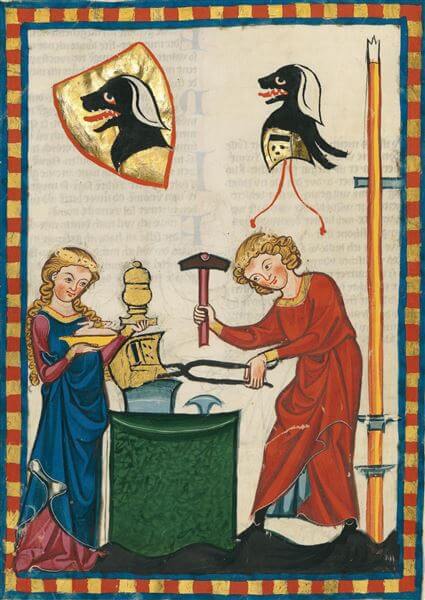
Hartmann von Starkenberg
Hartmann von Starkenberg was a 13th-century Minnesänger and probably belonged to the Tyrolean ministerial family of Starkenberg, based at Starkenberg Castle near Imst. His exact identity, however, remains uncertain. Three Minnelieder by him have survived, dealing primarily with love for a distant and unattainable woman. They are preserved in the Codex Manesse, which also depicts Hartmann in a dedicated miniature.
Hartmann von Starkenberg
Heidelberg, Universitätsbibliothek Heidelberg, Cod. Pal. germ. 848
Große Heidelberger Liederhandschrift (Codex Manesse)
Zurich, c. 1300 -c.1340
Hartmann von Starkenberg
Heidelberg, Universitätsbibliothek Heidelberg, Cod. Pal. germ. 848
Große Heidelberger Liederhandschrift (Codex Manesse)
Zurich, c. 1300 -c.1340

Der wilde Alexander
Der Wilde Alexander, also known as Meister Alexander, was a 13th-century travelling singer and poet, probably from southern Germany. His songs and Sangsprüche deal with love, religious and moral questions, as well as contemporary political events. Several of his melodies have survived, making his work particularly significant for the history of medieval music. His texts are preserved, among other sources, in the Codex Manesse and the Jena Song Manuscript.
Der wilde Alexander
Heidelberg, Universitätsbibliothek Heidelberg, Cod. Pal. germ. 848
Große Heidelberger Liederhandschrift (Codex Manesse)
Zurich, c. 1300 -c.1340
Der wilde Alexander
Heidelberg, Universitätsbibliothek Heidelberg, Cod. Pal. germ. 848
Große Heidelberger Liederhandschrift (Codex Manesse)
Zurich, c. 1300 -c.1340
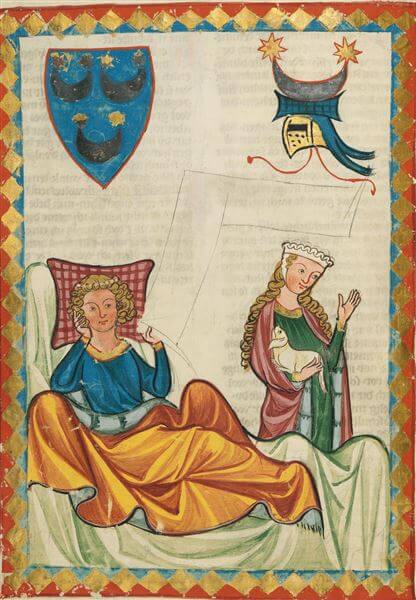
Heinrich von Morungen
Heinrich von Morungen was one of the most important Minnesänger active around 1200. He probably came from central Germany and was for a time associated with the court of the Margrave of Meissen. His songs belong to the tradition of courtly love poetry and are distinguished by particularly vivid imagery. The beloved woman often appears as an unattainable, almost idealised figure. Accordingly, the Codex Manesse depicts Morungen as a lovesick singer resting exhausted on his bed. His works are preserved primarily in this manuscript.
Herr Heinrich von Morungen
Heidelberg, Universitätsbibliothek Heidelberg, Cod. Pal. germ. 848
Große Heidelberger Liederhandschrift (Codex Manesse)
Zurich, c. 1300 -c. 1340
Herr Heinrich von Morungen
Heidelberg, Universitätsbibliothek Heidelberg, Cod. Pal. germ. 848
Große Heidelberger Liederhandschrift (Codex Manesse)
Zurich, c. 1300 -c. 1340

Rudolf von Neuenburg
Rudolf von Neuenburg, also known as Rudolf von Fenis, was a count and Minnesänger of the late 12th century. He was probably identical with Count Rudolf II of Neuenburg, who is documented between 1158 and 1192 in what is now Switzerland. His songs belong to the early phase of High Minnesang and deal primarily with unfulfilled love and service to a woman of higher social rank. A strong influence from French and Provençal love poetry is particularly evident in both the form and the motifs of his songs.
Graf Rudolf von Neuenburg
Heidelberg, Universitätsbibliothek Heidelberg, Cod. Pal. germ. 848
Große Heidelberger Liederhandschrift (Codex Manesse)
Zurich, c. 1300 -c.1340
Graf Rudolf von Neuenburg
Heidelberg, Universitätsbibliothek Heidelberg, Cod. Pal. germ. 848
Große Heidelberger Liederhandschrift (Codex Manesse)
Zurich, c. 1300 -c.1340
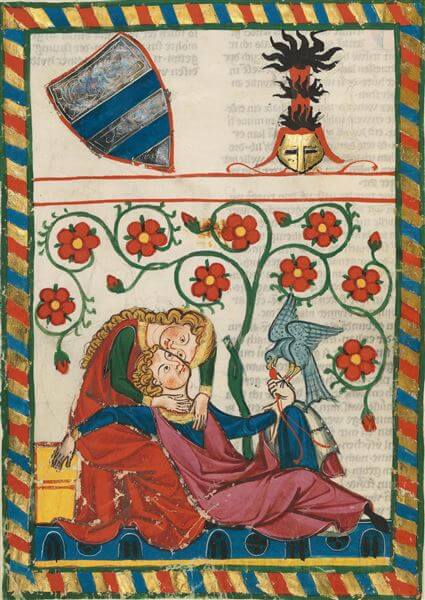
Konrad von Altstetten
Konrad von Altstetten was a Minnesänger of the late 13th or early 14th century and came from a ministerial family associated with the Abbey of St Gall. Three Minnelieder by him have survived, comprising a total of 13 stanzas. They combine images of nature with praise of the beloved woman and laments of love, and in some cases have the character of dance songs. His songs are preserved exclusively in the Codex Manesse, whose miniature depicts him in intimate proximity to a lady holding a falcon.
Herr Konrad von Altstetten
Heidelberg, Universitätsbibliothek Heidelberg, Cod. Pal. germ. 848
Große Heidelberger Liederhandschrift (Codex Manesse)
Zurich, c. 1300 -c.1340
Herr Konrad von Altstetten
Heidelberg, Universitätsbibliothek Heidelberg, Cod. Pal. germ. 848
Große Heidelberger Liederhandschrift (Codex Manesse)
Zurich, c. 1300 -c.1340

Friedrich von Sonnenburg
Friedrich von Sonnenburg was a 13th-century travelling singer and poet, probably from the Puster Valley. His Sangsprüche address religious and moral questions, political issues and the living conditions of travelling performers. He also discusses the singers’ dependence on the generosity of their aristocratic patrons. His works are preserved in several important manuscripts, including the Codex Manesse and the Jena Song Manuscript.
Meister Friedrich von Sonnenburg
Heidelberg, Universitätsbibliothek Heidelberg, Cod. Pal. germ. 848
Große Heidelberger Liederhandschrift (Codex Manesse)
Zurich, c. 1300 -c. 1340
Meister Friedrich von Sonnenburg
Heidelberg, Universitätsbibliothek Heidelberg, Cod. Pal. germ. 848
Große Heidelberger Liederhandschrift (Codex Manesse)
Zurich, c. 1300 -c. 1340

Dietmar der Setzer
Dietmar der Setzer was a 13th-century travelling singer and poet, about whose life very little is known. Four Sangsprüche by him have survived, in which he warns, among other things, against false prophets and calls upon noble lords to be generous. His texts thus address an important concern of travelling singers, whose livelihood depended on the support of their patrons. In the Codex Manesse, Dietmar is depicted as a knight at a tournament, although his actual noble origins remain uncertain.
Herr Dietmar der Setzer
Heidelberg, Universitätsbibliothek Heidelberg, Cod. Pal. germ. 848
Große Heidelberger Liederhandschrift (Codex Manesse)
Zurich, c. 1300 -c.1340
Herr Dietmar der Setzer
Heidelberg, Universitätsbibliothek Heidelberg, Cod. Pal. germ. 848
Große Heidelberger Liederhandschrift (Codex Manesse)
Zurich, c. 1300 -c.1340

Kristan von Hamle
Kristan von Hamle was a Minnesänger active in the first decades of the 13th century and probably came from central Germany, perhaps from Thuringia. Nothing certain is known about his life, and he has so far not been identified in documentary sources. His songs belong to the tradition of courtly Minnesang and focus primarily on love, praise of the beloved woman and the hope that love may be fulfilled. They are preserved in the Codex Manesse, which also depicts Kristan in a dedicated miniature.
Herr Kristan von Hamle
Heidelberg, Universitätsbibliothek Heidelberg, Cod. Pal. germ. 848
Große Heidelberger Liederhandschrift (Codex Manesse)
Zurich, c. 1300 -c.1340
Herr Kristan von Hamle
Heidelberg, Universitätsbibliothek Heidelberg, Cod. Pal. germ. 848
Große Heidelberger Liederhandschrift (Codex Manesse)
Zurich, c. 1300 -c.1340