
Music at court
At Tyrolean noble courts and fortified castles, a highly specialised culture of secular music developed that also served as an instrument of political power and social distinction.
Knightly Minnesang (a German form of lyrical love song) was the exclusive art form of this elite. It combined sophisticated Middle High German poetry with monophonic melodies governed by strict aesthetic conventions. Minnesang is commonly divided into Hohe Minne, or idealised courtly love, and Niedere Minne, forms that reflected different social ideals. Hohe Minne centred on the ritualised courtship of a married noblewoman of higher social rank. This love was never meant to be fulfilled. The singer presented himself as a loyal, suffering vassal who demonstrated his moral discipline and courtly refinement by renouncing the lady he desired. Niedere Minne, often represented by so-called Mädchenlieder, or “maiden songs”, dealt instead with mutual and fulfilled love involving women of lower social status, such as a shepherdess. These songs were often livelier, more rhythmically pronounced and closer to the forms of dance music.
The performance of such songs was an important part of life at castles such as Tyrol Castle, Rodenegg Castle and Runkelstein Castle. Singers performed their works in the great hall before the assembled nobility. Since the melodies of secular music in the Tyrolean region were almost never written down during the High Middle Ages, performance practice remained highly flexible. The performers accompanied themselves on portable instruments such as the fiddle or harp. Their performance relied on a subtle interplay between a memorised basic framework and spontaneous melodic ornamentation, which the singer could adapt to the mood and response of the audience. Music was also a direct marker of status. A nobleman who welcomed and rewarded travelling singers demonstrated his wealth, his appreciation of the arts and his connections beyond the region.
These songs were by no means merely light entertainment at banquets. They conveyed political messages, addressed legal disputes, circulated current news from across the Empire and discussed theological issues such as the Crusades. In the Late Middle Ages, this courtly environment changed profoundly. With the rise of urban culture and the growing economic strength of the nobility, musical forms also evolved. The traditional monophony of Minnesang was increasingly complemented by complex mensural notation, which made it possible to compose secular songs in several voices. Different melodies and texts could now be layered contrapuntally, creating entirely new demands on the training of court musicians.
Knightly Minnesang (a German form of lyrical love song) was the exclusive art form of this elite. It combined sophisticated Middle High German poetry with monophonic melodies governed by strict aesthetic conventions. Minnesang is commonly divided into Hohe Minne, or idealised courtly love, and Niedere Minne, forms that reflected different social ideals. Hohe Minne centred on the ritualised courtship of a married noblewoman of higher social rank. This love was never meant to be fulfilled. The singer presented himself as a loyal, suffering vassal who demonstrated his moral discipline and courtly refinement by renouncing the lady he desired. Niedere Minne, often represented by so-called Mädchenlieder, or “maiden songs”, dealt instead with mutual and fulfilled love involving women of lower social status, such as a shepherdess. These songs were often livelier, more rhythmically pronounced and closer to the forms of dance music.
The performance of such songs was an important part of life at castles such as Tyrol Castle, Rodenegg Castle and Runkelstein Castle. Singers performed their works in the great hall before the assembled nobility. Since the melodies of secular music in the Tyrolean region were almost never written down during the High Middle Ages, performance practice remained highly flexible. The performers accompanied themselves on portable instruments such as the fiddle or harp. Their performance relied on a subtle interplay between a memorised basic framework and spontaneous melodic ornamentation, which the singer could adapt to the mood and response of the audience. Music was also a direct marker of status. A nobleman who welcomed and rewarded travelling singers demonstrated his wealth, his appreciation of the arts and his connections beyond the region.
These songs were by no means merely light entertainment at banquets. They conveyed political messages, addressed legal disputes, circulated current news from across the Empire and discussed theological issues such as the Crusades. In the Late Middle Ages, this courtly environment changed profoundly. With the rise of urban culture and the growing economic strength of the nobility, musical forms also evolved. The traditional monophony of Minnesang was increasingly complemented by complex mensural notation, which made it possible to compose secular songs in several voices. Different melodies and texts could now be layered contrapuntally, creating entirely new demands on the training of court musicians.
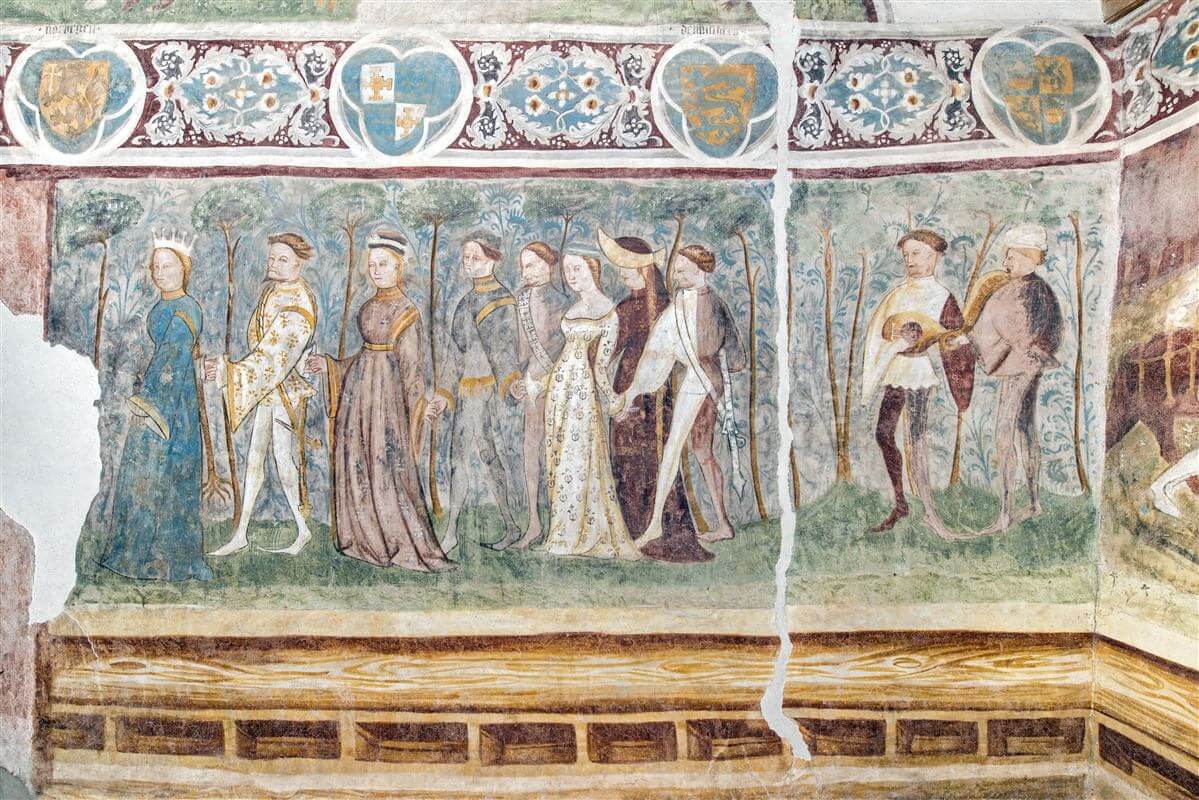
The wall paintings of Runkelstein Castle near Bozen are among the most important surviving cycles of secular medieval frescoes in the Alpine region.
Particularly well known is the depiction of a courtly round dance in the Tournament Hall of the West Palace. Women and men move together in an ordered line through a stylised landscape. The scene forms part of a larger pictorial programme depicting courtly entertainments. Musical accompaniment by lute and fiddle is also shown. Such dances could be accompanied by instruments or combined with singing by the dancers themselves.
Detail of the fresco cycle in the West Palace of Runkelstein Castle near Bozen
Bolzano Castles Foundation
Particularly well known is the depiction of a courtly round dance in the Tournament Hall of the West Palace. Women and men move together in an ordered line through a stylised landscape. The scene forms part of a larger pictorial programme depicting courtly entertainments. Musical accompaniment by lute and fiddle is also shown. Such dances could be accompanied by instruments or combined with singing by the dancers themselves.
Detail of the fresco cycle in the West Palace of Runkelstein Castle near Bozen
Bolzano Castles Foundation