From fragment to instrument
The reconstruction process provides the methodological link between the scientific analysis of material fragments and the practical testing of historical music. An archaeological find or the depiction of an instrument in a fresco remains silent evidence until the object is reconstructed and played.
The path from fragment to playable instrument resembles a scientific experiment. Instrument makers and archaeologists must justify every step on the basis of historical sources. If an instrument survives only in fragmentary form, the missing parts must be reconstructed by comparison with contemporary parallel finds or through detailed analysis of visual sources.
Modern materials and construction techniques must not be used. Historical reconstruction requires the use of traditional craft techniques. Instrument makers use local woods such as spruce or maple, felled according to historical criteria, and fit strings painstakingly twisted from sheep gut. Only this fidelity to historical materials allows the physical vibration behaviour of the reconstruction to approach that of the original instrument.
The path from fragment to playable instrument resembles a scientific experiment. Instrument makers and archaeologists must justify every step on the basis of historical sources. If an instrument survives only in fragmentary form, the missing parts must be reconstructed by comparison with contemporary parallel finds or through detailed analysis of visual sources.
Modern materials and construction techniques must not be used. Historical reconstruction requires the use of traditional craft techniques. Instrument makers use local woods such as spruce or maple, felled according to historical criteria, and fit strings painstakingly twisted from sheep gut. Only this fidelity to historical materials allows the physical vibration behaviour of the reconstruction to approach that of the original instrument.
The angular harp from Fritzens
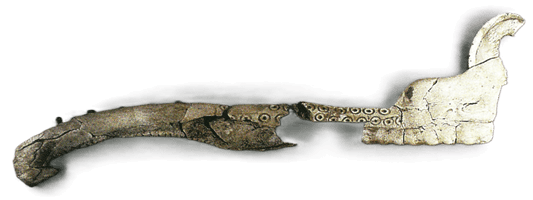
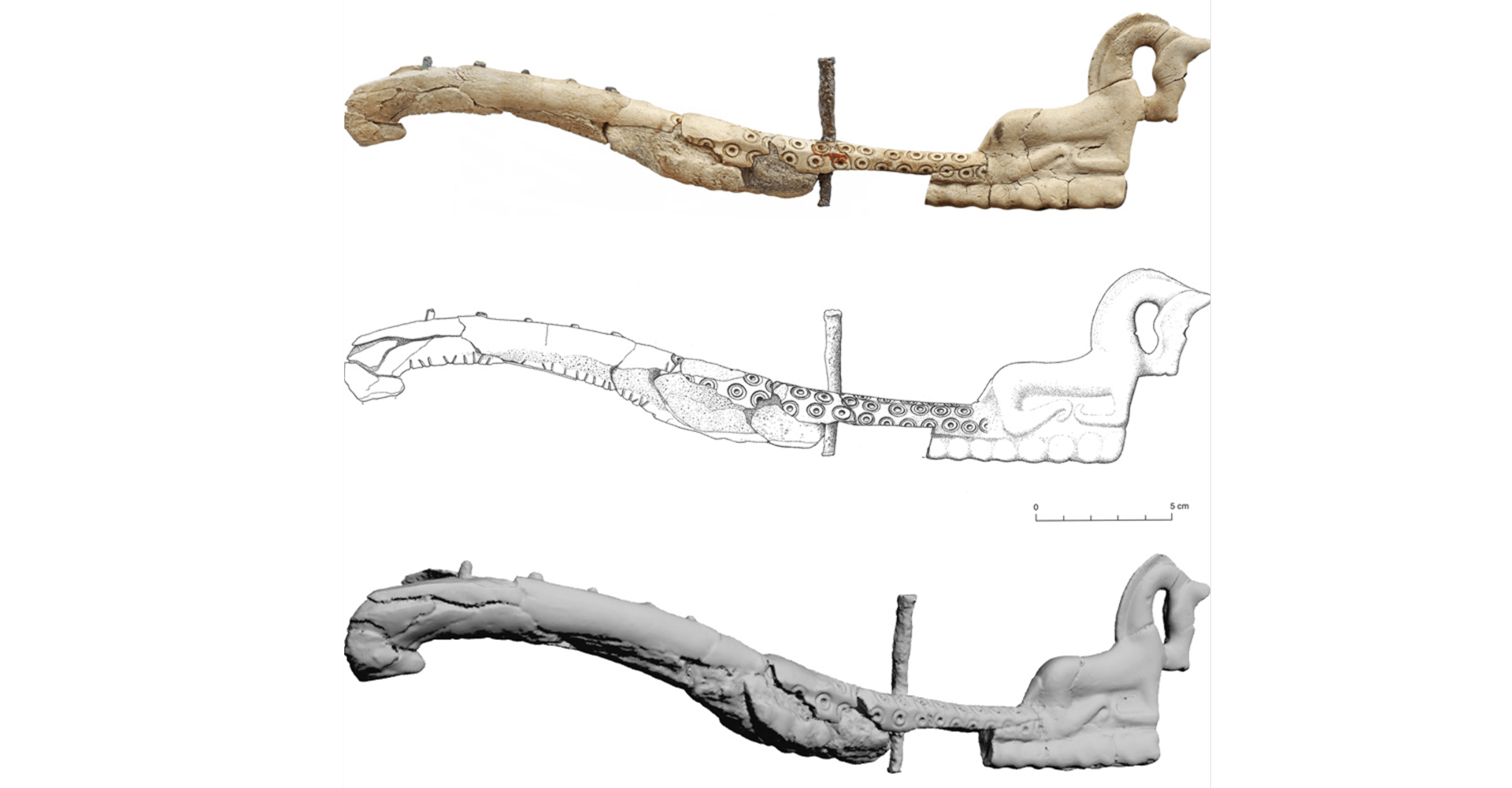
During excavations around the year 2000 in the Raetian settlement at Pirchboden near Fritzens, Gerhard Tomedi discovered fragments of a worked red deer antler. Their form, traces of working, fastening elements, and comparisons with visual sources and archaeological finds led to their interpretation as the neck of an angular harp. Within the Raetian cultural area, no known parallels for this instrument have so far been identified. The instrument shown here was visualised on the basis of the documented traces and archaeological finds, while the neck itself was milled in wood using the digital model.
The fragments were recorded three-dimensionally and assembled in a digital model. On this basis, missing areas could be supplemented and the original form of the neck reconstructed. The model made the spatial relationships between the individual broken pieces visible and at the same time provided the technical basis for producing the wooden reconstruction.
The data from the digital model were transferred to a computer-controlled milling machine. This gradually worked the reconstructed form out of a block of wood. Curves, recesses and sculptural ornament were created through the precise removal of material. In this way, the digital reconstruction became a real component of the playable instrument.
The completed neck reproduces the reconstructed form of the find in wood. It was joined at an almost right angle to a trough-shaped hollowed resonator covered with rawhide. The strings were attached to the neck by rings and toggles and could thus be tuned. Form and construction follow the archaeological evidence, even though the original material of the resonator has not survived.
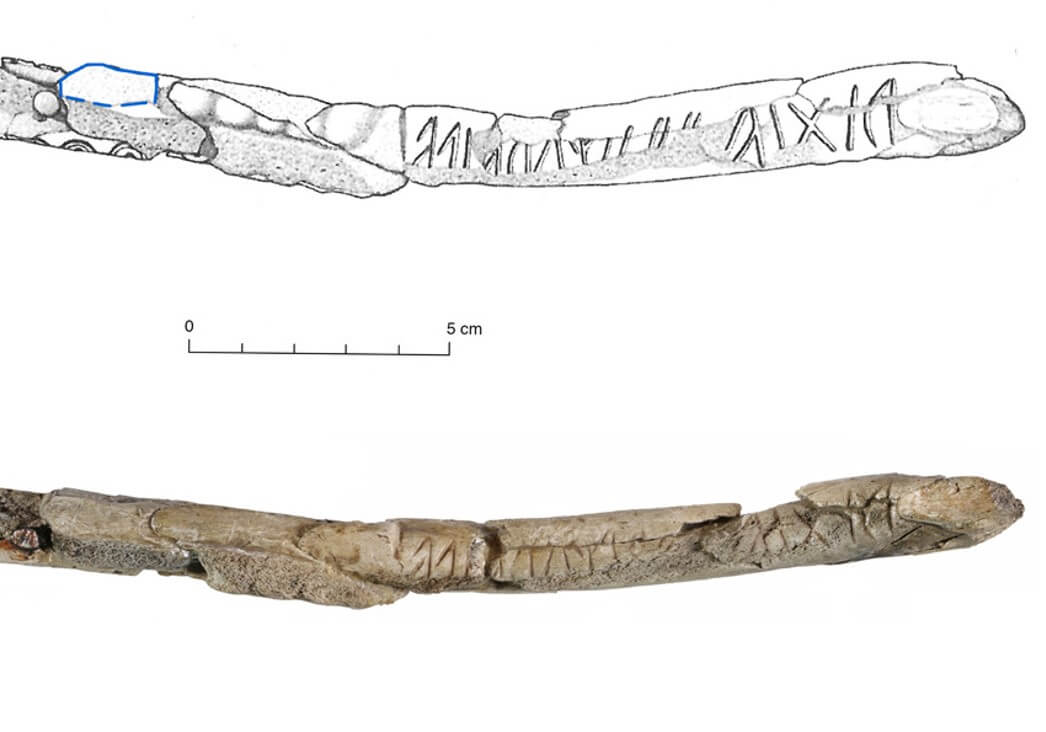
An incised inscription appears on the harp neck, but it is difficult to recognise clearly in direct view. A graphic tracing makes the individual signs and their course easier to see. The sequence of signs can with great probability be identified as a personal name. Whom it referred to remains unclear. The most likely interpretation is that it was an owner’s inscription.
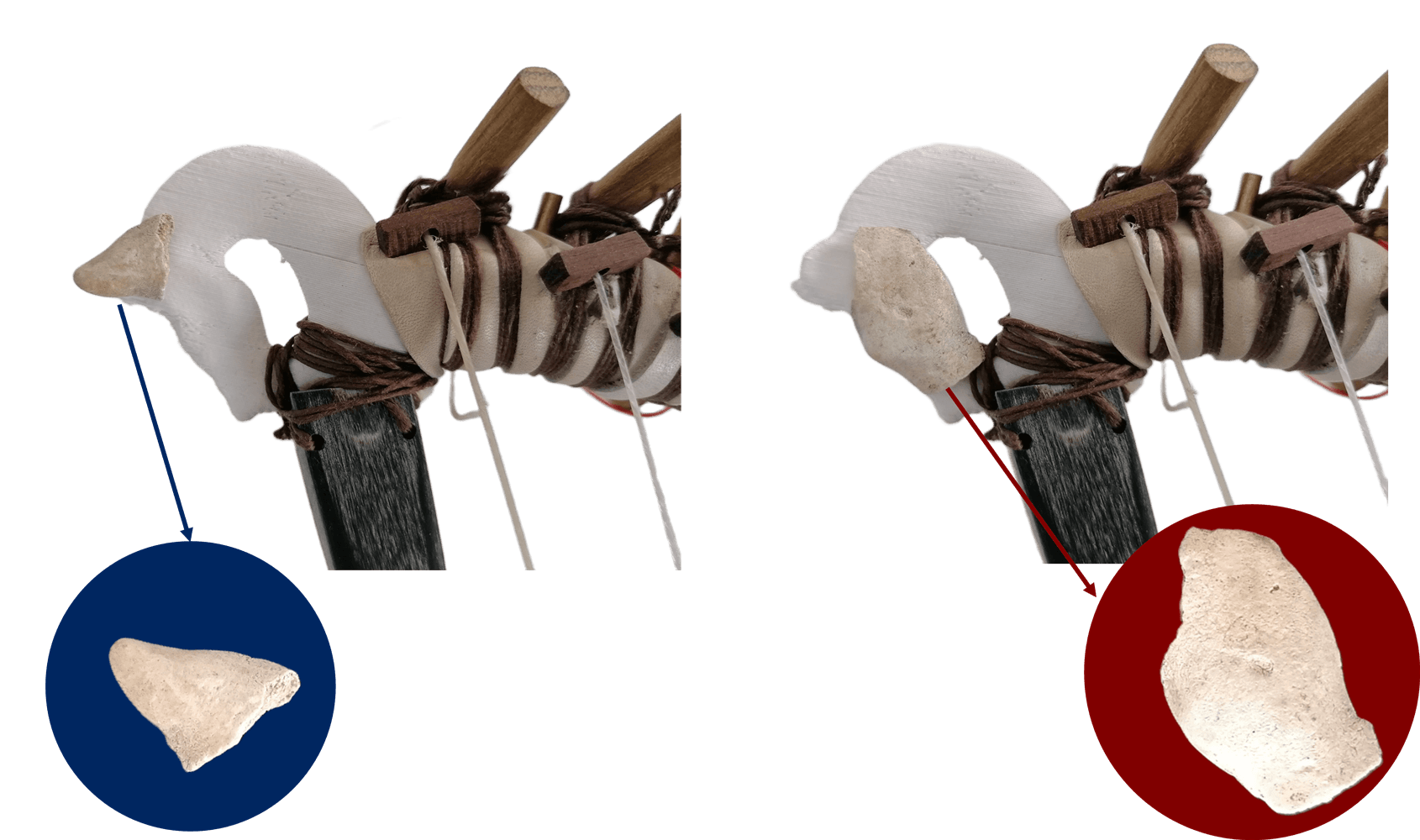
The reconstruction began with the surviving fragments of the harp neck. Bronze pins, an iron pin, and fine traces of wear and polishing provided clues to the original construction and the fastening of the strings. The individual fragments were carefully documented and matched with one another. From these material traces, the form of the instrument could gradually be reconstructed.
The sculpted horse’s head at the front end of the harp neck survived only in separate pieces. The small ear lobes, too, were found as broken fragments. Only through the precise matching and virtual reassembly of the pieces was it possible to determine their original position.
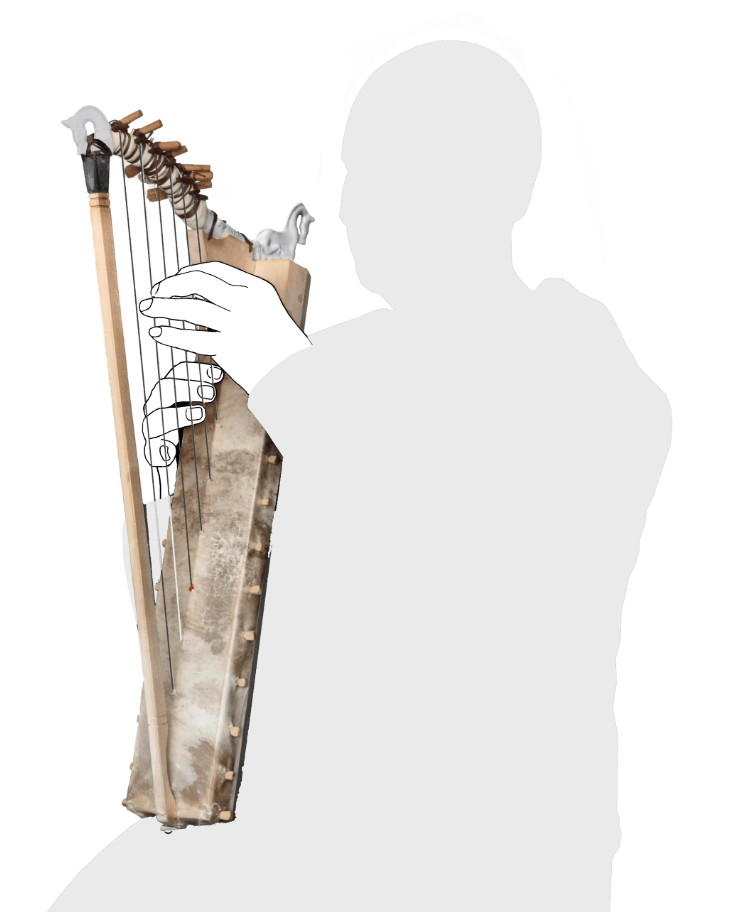
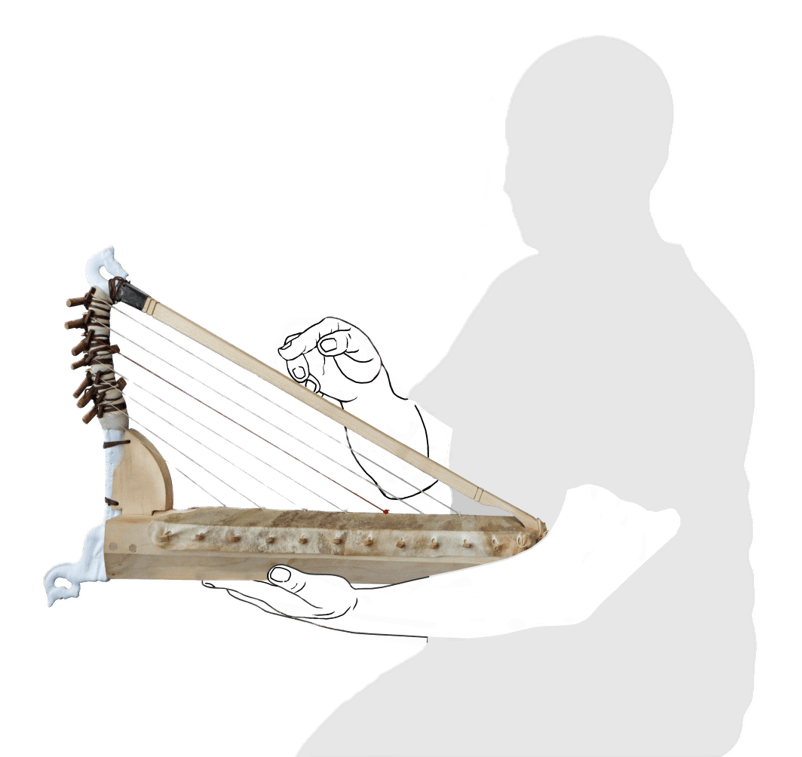
The tuning and exact playing technique of the angular harp have not been transmitted. Experiments with the reconstruction show, however, that the sound changes noticeably depending on how the instrument is held. Decisive factors are the way the resonator is positioned and how freely the rawhide can vibrate. The instrument was probably held vertically in front of the body and plucked with the fingers, comparable to the playing posture of a small contemporary figurine from Sesto al Reghena, now in the museum in Portogruaro. A single definite playing position, however, cannot be proven.
Original condition of the angular harp fragments
Reassembly of the fragments
G. Tomedi
Audio sample of the angular harp struck with a mallet:
Audio sample of the angular harp plucked:
The fragments were recorded three-dimensionally and assembled in a digital model. On this basis, missing areas could be supplemented and the original form of the neck reconstructed. The model made the spatial relationships between the individual broken pieces visible and at the same time provided the technical basis for producing the wooden reconstruction.
The data from the digital model were transferred to a computer-controlled milling machine. This gradually worked the reconstructed form out of a block of wood. Curves, recesses and sculptural ornament were created through the precise removal of material. In this way, the digital reconstruction became a real component of the playable instrument.
The completed neck reproduces the reconstructed form of the find in wood. It was joined at an almost right angle to a trough-shaped hollowed resonator covered with rawhide. The strings were attached to the neck by rings and toggles and could thus be tuned. Form and construction follow the archaeological evidence, even though the original material of the resonator has not survived.
An incised inscription appears on the harp neck, but it is difficult to recognise clearly in direct view. A graphic tracing makes the individual signs and their course easier to see. The sequence of signs can with great probability be identified as a personal name. Whom it referred to remains unclear. The most likely interpretation is that it was an owner’s inscription.
The reconstruction began with the surviving fragments of the harp neck. Bronze pins, an iron pin, and fine traces of wear and polishing provided clues to the original construction and the fastening of the strings. The individual fragments were carefully documented and matched with one another. From these material traces, the form of the instrument could gradually be reconstructed.
The sculpted horse’s head at the front end of the harp neck survived only in separate pieces. The small ear lobes, too, were found as broken fragments. Only through the precise matching and virtual reassembly of the pieces was it possible to determine their original position.
The tuning and exact playing technique of the angular harp have not been transmitted. Experiments with the reconstruction show, however, that the sound changes noticeably depending on how the instrument is held. Decisive factors are the way the resonator is positioned and how freely the rawhide can vibrate. The instrument was probably held vertically in front of the body and plucked with the fingers, comparable to the playing posture of a small contemporary figurine from Sesto al Reghena, now in the museum in Portogruaro. A single definite playing position, however, cannot be proven.
Original condition of the angular harp fragments
Reassembly of the fragments
G. Tomedi
Audio sample of the angular harp struck with a mallet:
Audio sample of the angular harp plucked:
The One-Handed Flute from Lengberg Castle
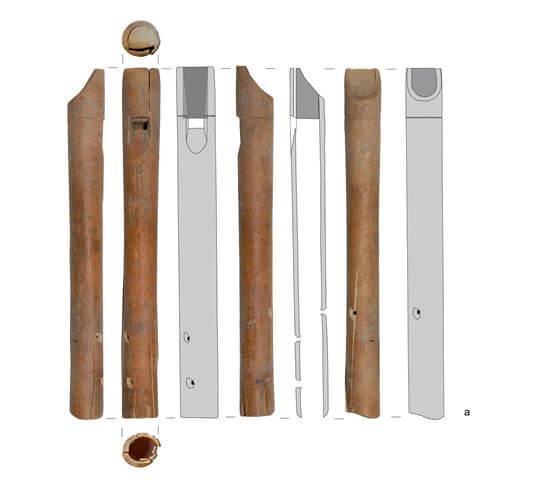
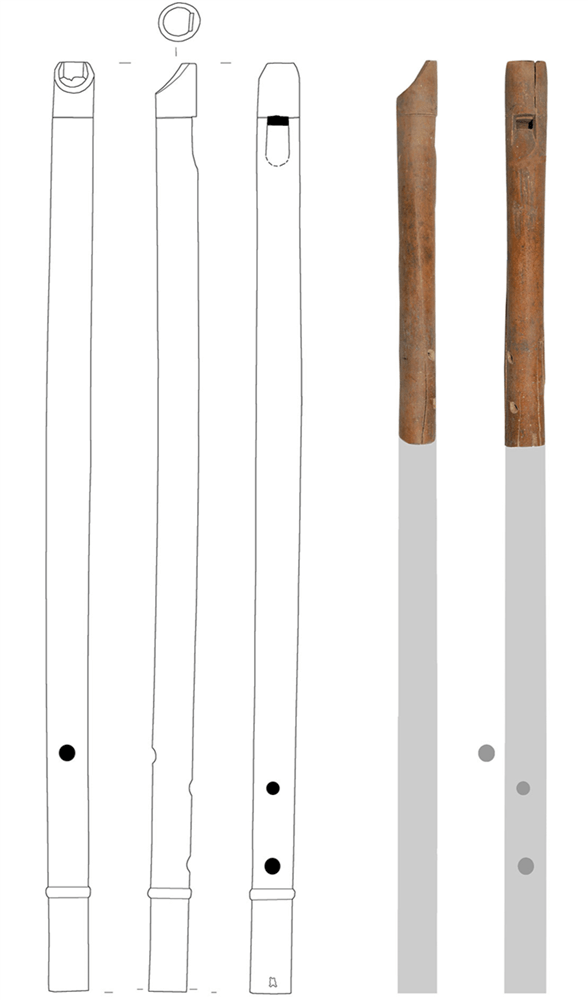
The flute from Lengberg Castle near Nikolsdorf in East Tyrol is so far the only surviving wooden find of a one-handed flute from Tyrol. The fragment was discovered in 2008 in a dry ceiling fill, a context that allowed organic materials to survive. The flute is made of maple wood and dates to the 15th century. The surviving parts comprise the head of the flute with its windway and labium, as well as part of the tube with finger holes.
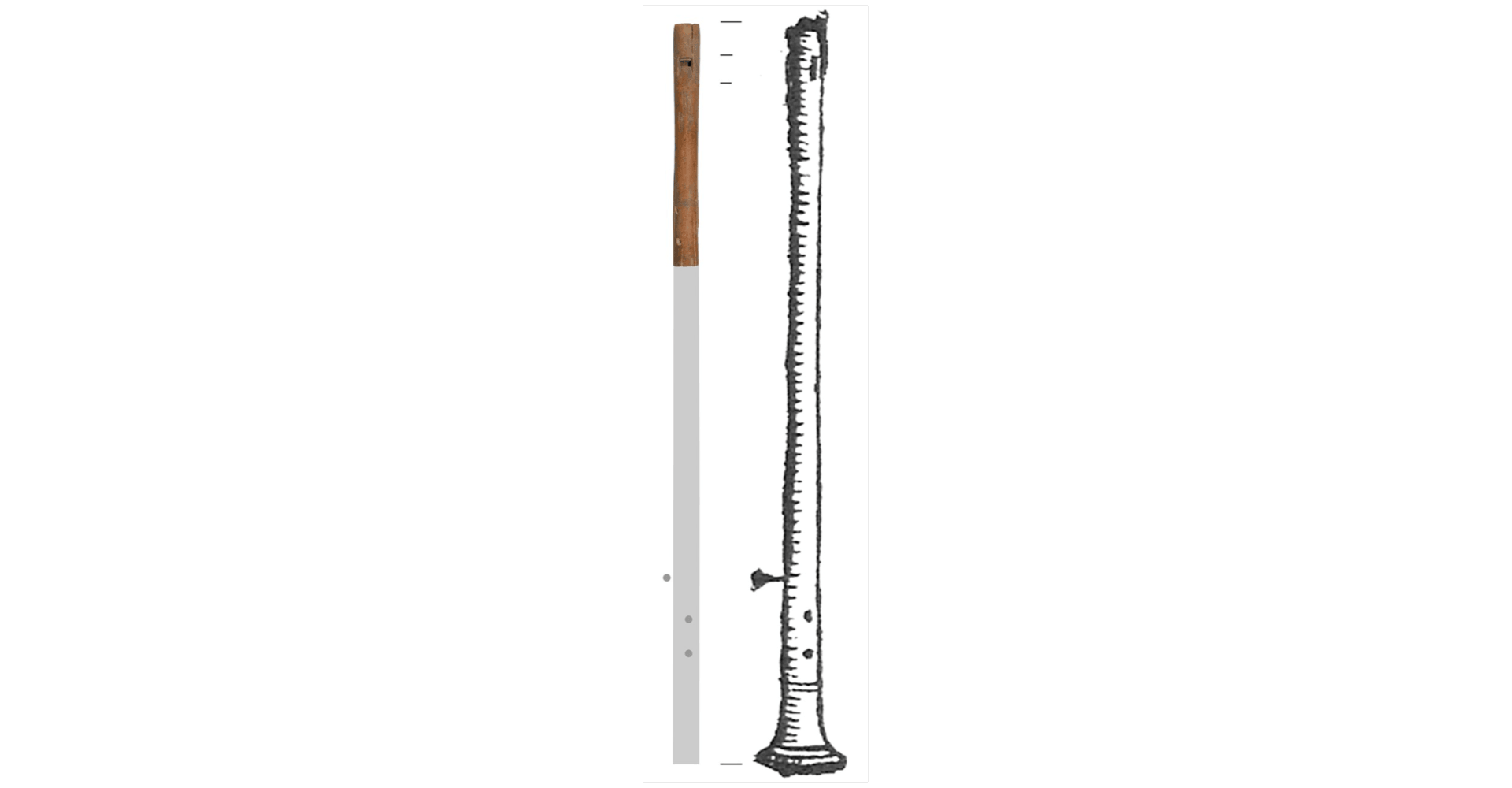
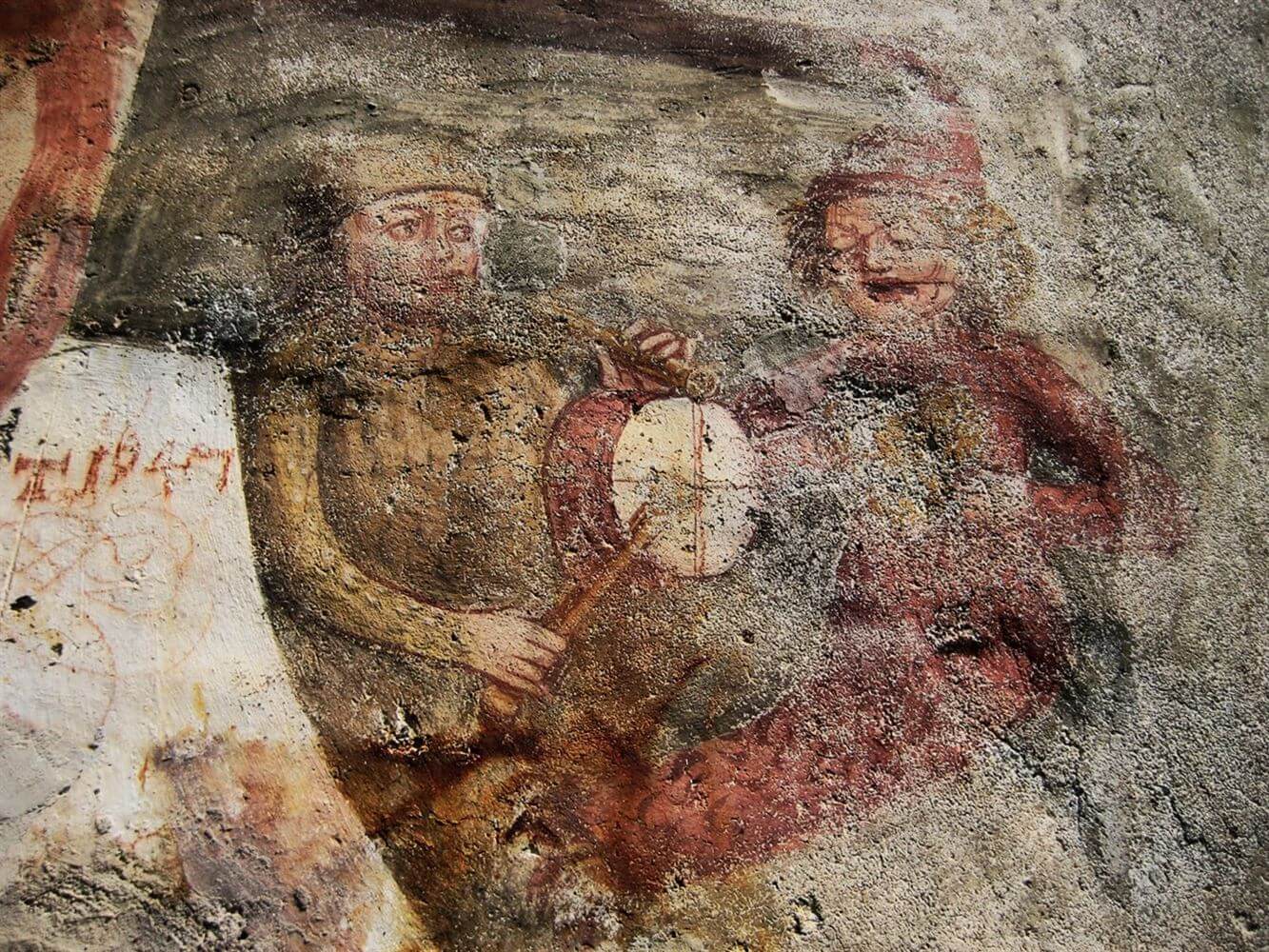
In his work published in the early 17th century, Praetorius described and illustrated numerous musical instruments of his time. One-handed flutes were played with one hand, while the other simultaneously struck a drum. The Lengberg find was probably originally intended as such an instrument, considerably longer than its surviving form, but was never completed in this form.
An important comparative find comes from the English warship Mary Rose, which sank in 1545. Several one-handed flutes were recovered from the wreck and provide a particularly clear illustration of this type of instrument. Comparison with these more complete finds shows that the Lengberg flute was originally designed to be longer. The Tyrolean find therefore preserves only the upper part of an instrument that had initially been planned differently.
After a break or other damage, the originally intended instrument was reworked. The surviving upper section was shortened and reused with a new arrangement of finger holes. Comparable finds of a similar size suggest that it was turned into a small flute, possibly intended for a child. The find therefore reveals two phases of use: first as a planned one-handed flute, and later after its conversion into a smaller instrument.
Clear traces of working can be seen at the lower end of the surviving fragment. After it was cut, the edge was carefully bevelled, meaning that it was smoothed at an angle and its sharp edge removed. This reworking shows that the piece did not simply break accidentally and get discarded, but was deliberately converted into a new instrument. Alongside the very simple and unprofessional manner in which the finger holes were made, the bevelling is therefore one of the most important indications of the second phase of construction and use.
The completed neck reproduces the reconstructed form of the find in wood. It was joined at an almost right angle to a trough-shaped hollowed resonator covered with rawhide. The strings were attached to the neck by rings and toggles and could thus be tuned. Form and construction follow the archaeological evidence, even though the original material of the resonator has not survived.
Audio sample of the flute at its original length:
Audio sample of the flute in its surviving state:
In his work published in the early 17th century, Praetorius described and illustrated numerous musical instruments of his time. One-handed flutes were played with one hand, while the other simultaneously struck a drum. The Lengberg find was probably originally intended as such an instrument, considerably longer than its surviving form, but was never completed in this form.
An important comparative find comes from the English warship Mary Rose, which sank in 1545. Several one-handed flutes were recovered from the wreck and provide a particularly clear illustration of this type of instrument. Comparison with these more complete finds shows that the Lengberg flute was originally designed to be longer. The Tyrolean find therefore preserves only the upper part of an instrument that had initially been planned differently.
After a break or other damage, the originally intended instrument was reworked. The surviving upper section was shortened and reused with a new arrangement of finger holes. Comparable finds of a similar size suggest that it was turned into a small flute, possibly intended for a child. The find therefore reveals two phases of use: first as a planned one-handed flute, and later after its conversion into a smaller instrument.
Clear traces of working can be seen at the lower end of the surviving fragment. After it was cut, the edge was carefully bevelled, meaning that it was smoothed at an angle and its sharp edge removed. This reworking shows that the piece did not simply break accidentally and get discarded, but was deliberately converted into a new instrument. Alongside the very simple and unprofessional manner in which the finger holes were made, the bevelling is therefore one of the most important indications of the second phase of construction and use.
The completed neck reproduces the reconstructed form of the find in wood. It was joined at an almost right angle to a trough-shaped hollowed resonator covered with rawhide. The strings were attached to the neck by rings and toggles and could thus be tuned. Form and construction follow the archaeological evidence, even though the original material of the resonator has not survived.
Audio sample of the flute at its original length:
Audio sample of the flute in its surviving state:
The Jew's Harps from Tyrol Castle
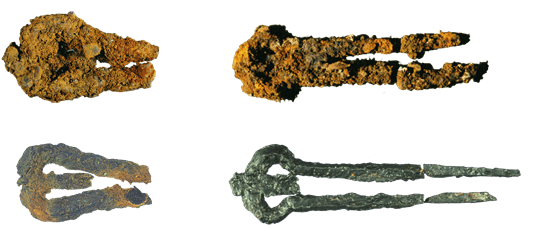
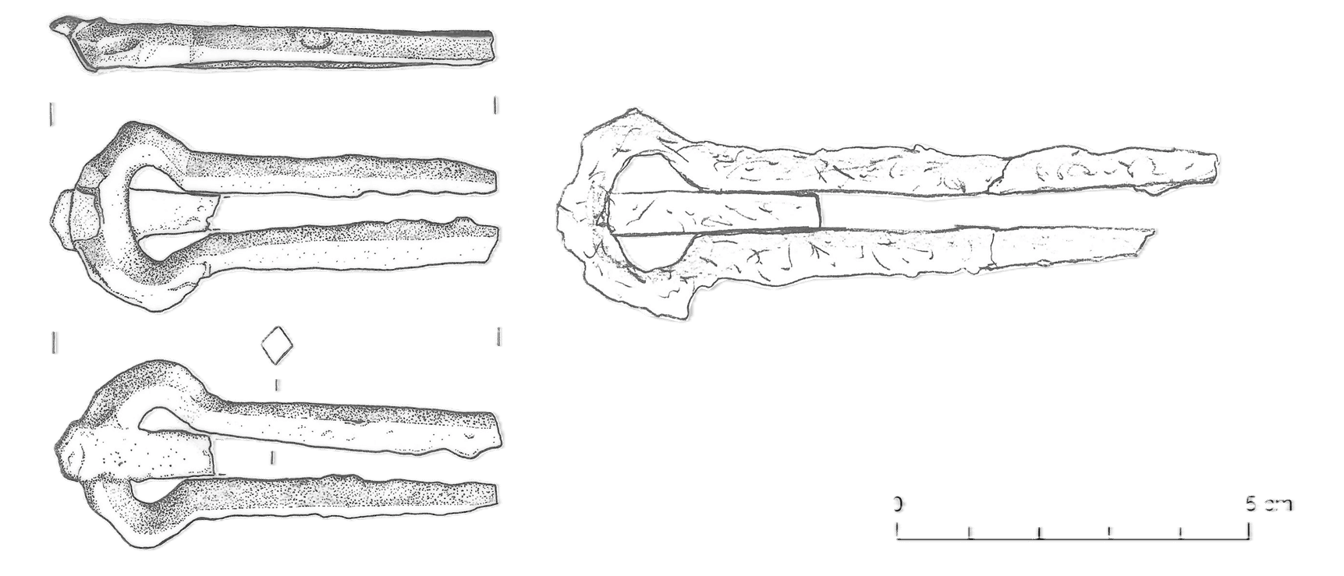
The two iron Jew’s harps were found in 1999 during excavations in the service wing of Tyrol Castle. Jew’s harp no. 1 lay in a fill layer containing numerous stones along the east wall of room 7. On stratigraphic grounds, it is dated to the 14th or 15th century and corresponds to the Gironville type according to G. Kolltveit. The second Jew’s harp was uncovered on 19 October 1999 in room W0.07 within a 17th-century levelling deposit. Its rounded triangular form belongs to the early modern Bruck type, again according to G. Kolltveit. The excavation drawing of Jew’s harp no. 1 records the heavily fragmented instrument in the condition in which it was found.
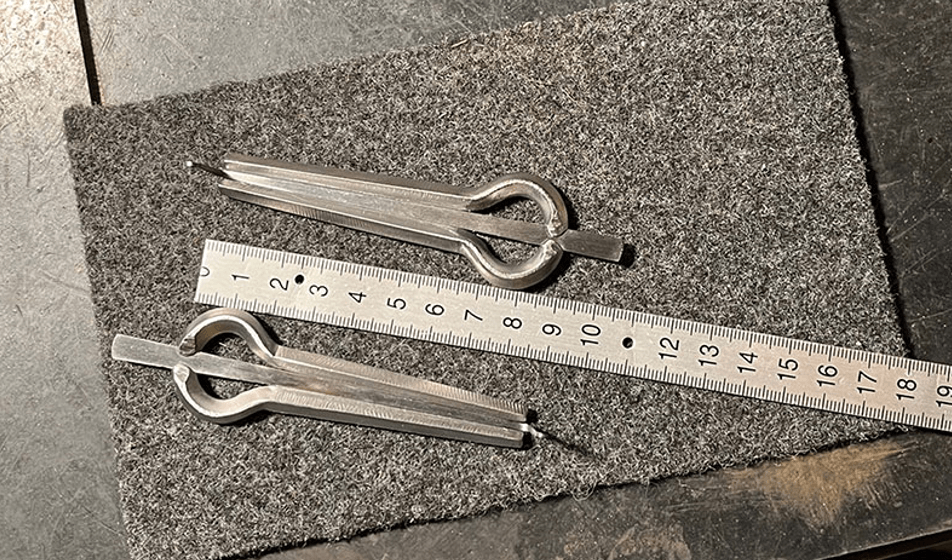
Both instruments are forged iron frame Jew’s harps. Between the two arms there originally ran a separately made elastic tongue, attached to the frame by hammering over the metal. In playing, the arms were positioned between the tightened lips and the tongue was plucked with a finger. The oral cavity amplified its vibration and shaped the overtones. Before restoration, the frame, arms and remains of the tongues were largely obscured by corrosion and adhering soil. After cleaning, their differing forms and traces of workmanship became visible. On Jew’s harp no. 2, traces of over-filing remained on the frame, along with fine file marks on the tongue.
Top left: Jew’s harp no. 2 before restoration
Bottom left: Jew’s harp no. 2 after restoration
Top right: Jew’s harp no. 1 before restoration
Bottom right: Jew’s harp no. 1 after restoration
Both instruments are forged iron frame Jew’s harps. Between the two arms there originally ran a separately made elastic tongue, attached to the frame by hammering over the metal. In playing, the arms were positioned between the tightened lips and the tongue was plucked with a finger. The oral cavity amplified its vibration and shaped the overtones. Before restoration, the frame, arms and remains of the tongues were largely obscured by corrosion and adhering soil. After cleaning, their differing forms and traces of workmanship became visible. On Jew’s harp no. 2, traces of over-filing remained on the frame, along with fine file marks on the tongue.
Top left: Jew’s harp no. 2 before restoration
Bottom left: Jew’s harp no. 2 after restoration
Top right: Jew’s harp no. 1 before restoration
Bottom right: Jew’s harp no. 1 after restoration
The bone flute from Tyrol Castle
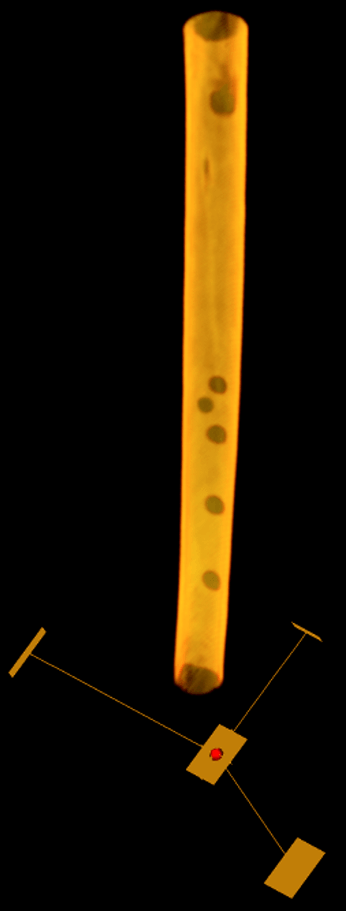
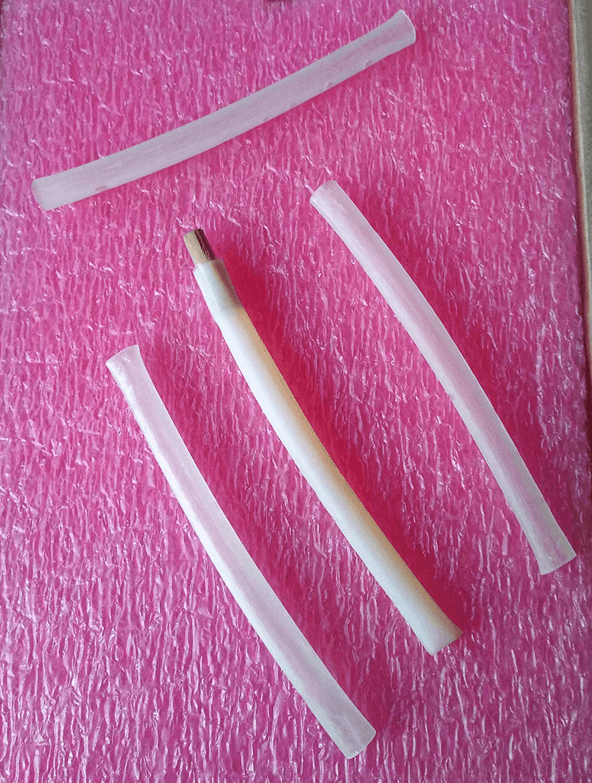
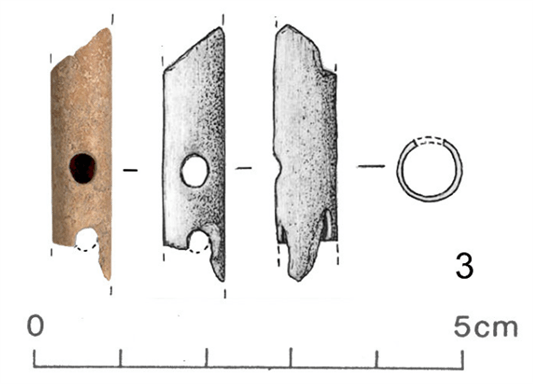
During excavations in the service wing of Tyrol Castle, a fragment of a flute measuring about three centimetres in length was discovered. The instrument was made from a tubular bone from a goose wing. Two finger holes, together with traces of drilling, grinding and smoothing, attest to careful workmanship. The head, blowing opening and lower end of the flute have not survived. Its original length and the total number of finger holes therefore remain unknown.
Another bone fragment may also have belonged to the instrument. Since the two pieces do not fit together directly, however, it cannot be established with certainty that they formed part of the same flute.
Fragment of a bone flute
early 14th century
goose ulna
Tyrol Castle, service wing
Audio sample of the bone flute from Tyrol Castle:
Another bone fragment may also have belonged to the instrument. Since the two pieces do not fit together directly, however, it cannot be established with certainty that they formed part of the same flute.
Fragment of a bone flute
early 14th century
goose ulna
Tyrol Castle, service wing
Audio sample of the bone flute from Tyrol Castle: