
Music in church
For many centuries, churches and monasteries were the most influential centres of musical practice in the Tyrolean region. Sacred musical life was strictly regulated and was not intended for simple entertainment, but for the performance of the Divine Office. The daily Liturgy of the Hours and the celebration of Mass required monks and nuns to master hundreds of complex melodies for the Ordinary and Proper of the Mass without error.
The architecture of medieval stone churches acted as an acoustic amplifier, carrying the human voice and allowing chant to resonate throughout the space. Until the 9th century, this tradition was based almost entirely on oral transmission and collective memory. The first forms of musical notation were developed in order to establish a uniform liturgy throughout the Empire. Monks began drawing small signs above the Latin texts. These so-called neumes represented the course of a melody through strokes, dots and wavy lines. They served as a graphic aid to memory, but were not written on a musical staff. They therefore could not indicate absolute pitches or precise intervals. Anyone who did not already know the melody could not simply read it from these early neumes.
A decisive change came around 1030 with the music theorist and monk Guido of Arezzo. He introduced a system of four staff lines arranged at intervals of a third and marking fixed pitches. Each note now had a fixed position in written space. This invention had a lasting impact on European cultural history, as music could now be transmitted, learned and preserved in written form.
In monastic scriptoria, such as that of the Augustinian Canons’ Abbey of Neustift near Brixen, these new forms of notation were readily adopted and refined. Scribes copied magnificent, extremely heavy choirbooks in what is known as square notation. These manuscripts contain highly complex liturgical forms such as tropes, in which existing chants were elaborately expanded with new textual and melodic sections, as well as the mournful Lamentations for the services of Holy Week.
Alongside this refinement of monophony, early forms of polyphony also developed in monasteries. Medieval theoretical treatises, including the Musica enchiriadis and the Scolica enchiriadis, provided a mathematical and theological basis for organum. In this early polyphonic practice, the traditional principal melody of Gregorian chant was accompanied by one or more additional voices at fixed consonant intervals of a fourth or fifth. The result was a solemn, block-like sonority intended to represent acoustically the hierarchical order of the cosmos.
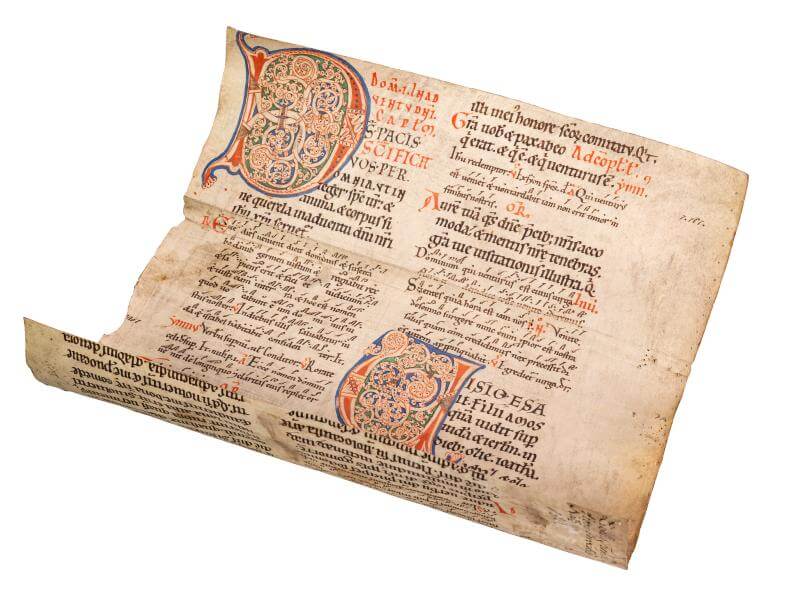
Neumes
Bifolium with neumes from an antiphoner (liturgical chant book)
southern German region
late 12th century
Neustift Abbey Library
Fragment no. 87

Guido von Arezzo
The development of the musical staff
Guido is also associated with the so-called Guidonian hand. Individual pitches were assigned to particular joints and areas of the hand. Teachers could point to these positions to teach their pupils sequences of notes and intervals. The staff and the use of the hand made it considerably easier to learn the extensive repertoire of liturgical chant.
Detail of the statue of Guido of Arezzo
Piazzale degli Uffizi, Florence
Sculptor: Lorenzo Nencini
Photograph: Riccardo Speziari
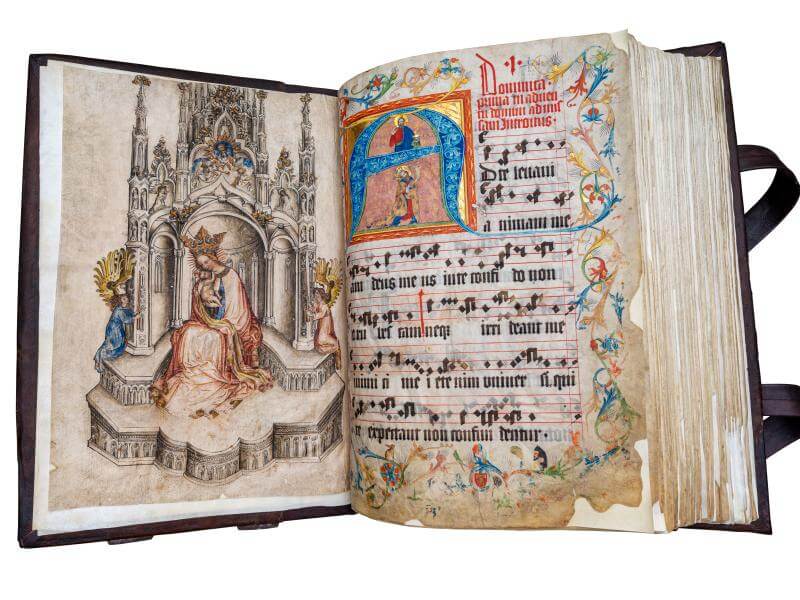
Graduale Neocellense
The Zollner Graduals
The Zollner Graduals from Neustift Abbey, measuring more than 70 cm in height, contained the chants of the Mass for the various feasts of the liturgical year. Their unusual size served a practical purpose: during services, the manuscript was placed on a lectern so that several singers could read from it at the same time. The script and musical notation were therefore also written on a large scale and remained clearly legible from some distance.
The two volumes were produced in the mid-15th century and written by Friedrich Zollner. Numerous coloured initials, figurative illustrations and gold leaf decoration make these books, created for liturgical use, exceptionally elaborate manuscripts.
Graduale Neocellense, the so-called Zollner Graduals
Volume I, IIv
Friedrich Zollner (c.1442)
Parchment, Latin manuscript
Photograph: Peter Daldos
Neustift Abbey Library, Cod. s.n.