
Music in town and at work
Away from monasteries and noble courts, a lively world of secular music shaped the lives of ordinary people in towns, markets and villages. This everyday musical culture was loud and pragmatic, and closely connected with festivities, work and ritual.
Travelling musicians, known as Spielleute, played a central role. They stood outside the medieval social order and often lacked civic rights, yet they were indispensable to social life. They performed at fairs, weddings and inns. Their repertoire was varied: they played dance music, sang coarse satirical songs, performed narrative ballads about crimes and misfortunes, and accompanied acrobatic displays. Since much of the population could neither read nor write, this musical culture was based on oral tradition. Instruments such as the bagpipe, hurdy-gurdy, portable flutes and simple drums dominated this soundscape. Their volume and carrying power made them particularly suitable for outdoor performance. In the urban markets of centres such as Bolzano, Sterzing and Merano, different social groups mingled. The music of the Spielleute provided entertainment for everyone, but often also gave expression to social discontent through satirical texts directed at the authorities.
In the towns of the 15th century, municipal authorities began to organise and regulate musical life. Clear evidence of this can be found in the Bolzano school regulations of 1424. They record the obligation of the town schoolmaster, known as the Junkmeister, to train the schoolboys in singing. These boys not only provided reliable musical accompaniment for services in the parish churches, but also regularly took part in secular events in the urban sphere.
An important feature of urban custom was the Bolzano Ansingen. As part of this New Year tradition, groups of singers moved through the streets and performed songs of blessing outside the houses of wealthy citizens, asking for money or goods in return. Music here fulfilled a clear economic and social function of exchange.
A particularly rich source for urban festive culture is the Sterzing Play Archive. This unique collection contains scripts and detailed stage directions for religious and secular plays performed in public marketplaces. These included Passion plays as well as coarse Shrovetide plays. Music was firmly integrated into these theatrical performances, which could last for several days. Schoolboys and town musicians provided sung interludes, accompanied the actors’ entrances and performed instrumental pieces to structure the scenes. These urban documents make tangible the transition from improvisation to performances organised in written form.
Travelling musicians, known as Spielleute, played a central role. They stood outside the medieval social order and often lacked civic rights, yet they were indispensable to social life. They performed at fairs, weddings and inns. Their repertoire was varied: they played dance music, sang coarse satirical songs, performed narrative ballads about crimes and misfortunes, and accompanied acrobatic displays. Since much of the population could neither read nor write, this musical culture was based on oral tradition. Instruments such as the bagpipe, hurdy-gurdy, portable flutes and simple drums dominated this soundscape. Their volume and carrying power made them particularly suitable for outdoor performance. In the urban markets of centres such as Bolzano, Sterzing and Merano, different social groups mingled. The music of the Spielleute provided entertainment for everyone, but often also gave expression to social discontent through satirical texts directed at the authorities.
In the towns of the 15th century, municipal authorities began to organise and regulate musical life. Clear evidence of this can be found in the Bolzano school regulations of 1424. They record the obligation of the town schoolmaster, known as the Junkmeister, to train the schoolboys in singing. These boys not only provided reliable musical accompaniment for services in the parish churches, but also regularly took part in secular events in the urban sphere.
An important feature of urban custom was the Bolzano Ansingen. As part of this New Year tradition, groups of singers moved through the streets and performed songs of blessing outside the houses of wealthy citizens, asking for money or goods in return. Music here fulfilled a clear economic and social function of exchange.
A particularly rich source for urban festive culture is the Sterzing Play Archive. This unique collection contains scripts and detailed stage directions for religious and secular plays performed in public marketplaces. These included Passion plays as well as coarse Shrovetide plays. Music was firmly integrated into these theatrical performances, which could last for several days. Schoolboys and town musicians provided sung interludes, accompanied the actors’ entrances and performed instrumental pieces to structure the scenes. These urban documents make tangible the transition from improvisation to performances organised in written form.
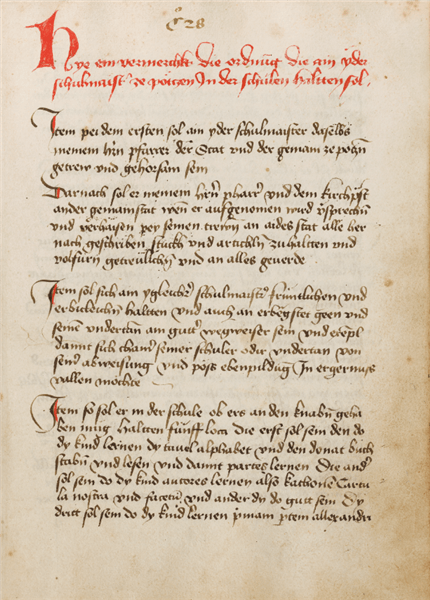
The Bozen School Regulations
The municipal authorities deliberately organised musical instruction to meet the city community’s ceremonial needs at festivities and religious services. The Bolzano school regulations of 1424, the oldest in Tyrol, contain instructions concerning the education and church singing of the parish schoolboys.
Register of property and legal records of the Parish Church of St Mary in Bozen, fol. 128r and 129v
1453/60
Bibliothèque nationale et universitaire Strasbourg, Ms. 2111, allemands 187
Register of property and legal records of the Parish Church of St Mary in Bozen, fol. 128r and 129v
1453/60
Bibliothèque nationale et universitaire Strasbourg, Ms. 2111, allemands 187
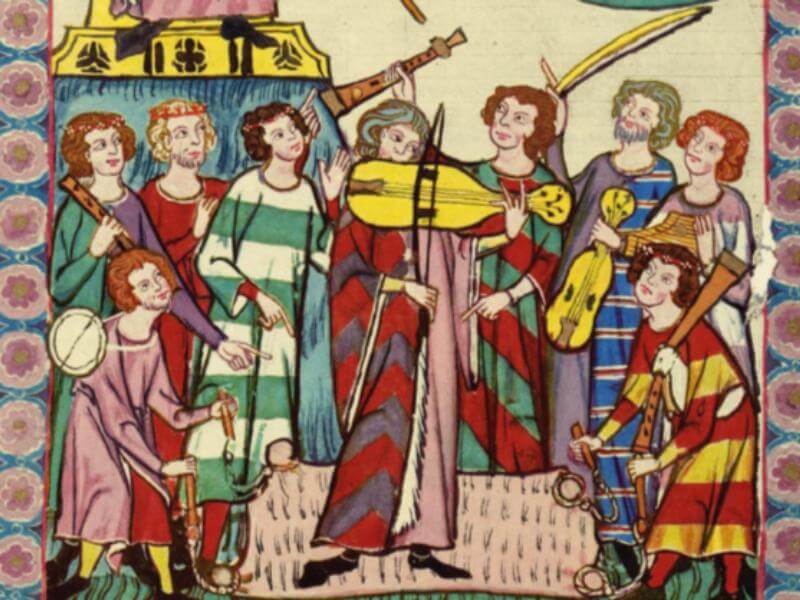
Minstrels
In the Middle Ages, minstrels travelled as musicians, singers, dancers and entertainers. Many moved from town to town and earned their living at festivals, fairs, weddings or in inns. They also performed at princely courts and accompanied public celebrations and processions. Their repertoire included not only music and dance, but also acting, acrobatics, jokes and feats of skill.
Minstrels came from different social backgrounds, although most belonged to the lower social strata. Their itinerant way of life also made them outsiders. Ecclesiastical authors warned against their music and performances, which could be regarded as offensive or morally dangerous. In many places, minstrels were also legally disadvantaged. Conspicuous clothing and little bells could outwardly identify them as members of an occupation regarded as “dishonourable”. Female minstrels faced additional prejudice, particularly when they performed as dancers.
Detail of the minstrels from Meister Heinrich Frauenlob
Große Heidelberger Liederhandschrift (Codex Manesse), fol. 399r
Universitätsbibliothek Heidelberg
Zurich, c. 1300 -c. 1340
Minstrels came from different social backgrounds, although most belonged to the lower social strata. Their itinerant way of life also made them outsiders. Ecclesiastical authors warned against their music and performances, which could be regarded as offensive or morally dangerous. In many places, minstrels were also legally disadvantaged. Conspicuous clothing and little bells could outwardly identify them as members of an occupation regarded as “dishonourable”. Female minstrels faced additional prejudice, particularly when they performed as dancers.
Detail of the minstrels from Meister Heinrich Frauenlob
Große Heidelberger Liederhandschrift (Codex Manesse), fol. 399r
Universitätsbibliothek Heidelberg
Zurich, c. 1300 -c. 1340