
De Re Metallica
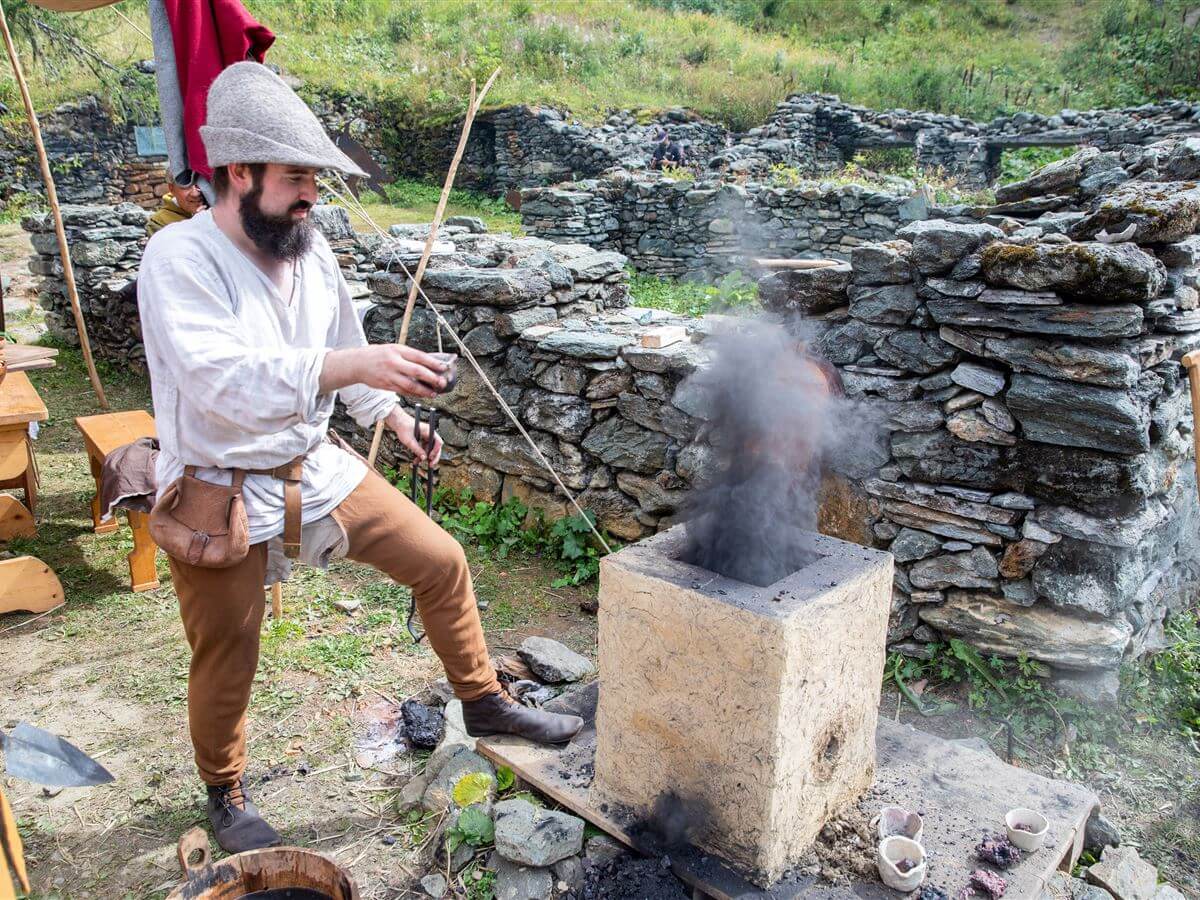
From 28 to 30 August 2026, the South Tyrol Museum of Mining in Prettau will become a time machine!
The fourth edition of De Re Metallica is dedicated to the theme of “Alchemy and Assaying”. The event begins on Friday, 28 August, with a programme of lectures exploring alchemy and historical assaying, and the ways in which people in the Middle Ages and Early Modern period understood substances, metals, and their transformation.
In her lecture “Opus Magnum: The Philosopher’s Stone”, Sofia Steger provides an introduction to medieval alchemy, contemporary ideas about the formation and transformation of metals, and the search for the Philosopher’s Stone. In his lecture “Trust Is Good, Testing Is Better”, Armin Torggler focuses on medieval assaying and explains the connections between the examination of ores, historical mineral-processing methods, and the chemical knowledge of the period.
Meanwhile, children can conduct their own experiments in the “Alchemy” workshop and discover chemical reactions and processes through a series of simple experiments.
You can already get into the spirit of the event with the new special exhibition “Fidula & Flauto”. It explores music in the Middle Ages and how historical instruments and sounds can be reconstructed today. To accompany the exhibition, Ensemble Tempus will present reconstructions of medieval instruments and perform medieval music at 7 p.m. on Friday, 28 August, in the Granary in Steinhaus.
On Saturday, 29 August, and Sunday, 30 August, the area around the Nikolaus Gallery of the former copper mine will once again be transformed into a historical setting where visitors can experience the past at close hand.
How was ore processed by hand? How could metal be extracted from an unassuming piece of rock? What knowledge was needed to assess ores, smelt them, and determine their composition? And what was everyday life like for the people who depended on mining for their livelihood?
Reenactment groups from South Tyrol, Trentino, Austria, and Germany demonstrate techniques, explain tools and working processes, and provide an insight into a period when mining, metal production, and crafts still depended largely on physical labour, experience, and knowledge passed down from generation to generation.
This is more than a staged performance. The participating groups work extensively with historical sources, archaeological finds, tools, and documented working techniques. Many of their demonstrations draw on experimental archaeology: historical processes are tested in practice using reconstructed equipment and materials that correspond as closely as possible to those used in the past.
Visitors can follow the individual working processes at close range and speak directly with the reenactors. Different aspects of historical mining and metalworking can be observed, from the processing and dressing of ore to craft techniques and the methods used to extract, assay, and further process metals.
Everyday life around the mine is also part of the programme. Historical clothing, tools, equipment, and camp life complement the demonstrations and provide an impression of the conditions in which miners and craftspeople lived and worked.
Programme
Friday, 28 August 2026
2 p.m. - Lecture in Prettau: “Opus Magnum: The Philosopher’s Stone”, Sofia Steger
3 p.m. - Lecture in Prettau: “Trust Is Good, Testing Is Better”, Armin Torggler
3-4 p.m. - Children’s workshop “Alchemy” in Prettau
7 p.m. - Medieval music in the Kornkasten, Steinhaus
Saturday, 29 August & Sunday, 30 August 2026
10 a.m.-5 p.m. - Medieval life and work at the Nikolaus Gallery in Prettau: historical reenactment with copper smelting, assaying, ore sorting, charcoal burning, and other historical crafts.